Home Blog Page 18

Monkeys with Smaller Testicles Compensate by Screaming Louder

Filed under “Testosterone” and “Social Media”: could this explain some of the comments on our Facebook page?

From the article on Discover Magazine:

Researchers used laser surface scanning to build 3-D anatomical models of hyoids from 255 male and female howler monkey specimens housed in various museums. They also analyzed the monkeys’ group dynamics based on literature published on each of the species they studied. They discovered a negative correlation between the size of males’ hyoids and the size of their testes, which points to the calls having a role in reproduction, not just communication and scaring away predators.

So maybe we don’t need Mark Zuckerberg to start checking for non-Human accounts just yet, but we’re still going to imply a little correlation because it’s funny, and because a lot of the comments on our FB page really do suck.

ATHLETES AT RISK: Time to Hold Abusers and Enablers Accountable

Final in a 5-part series

COMMENTARY by Cathy Chapaty

It’s time.

It’s long past time for the U.S. Olympic Committee (USOC) and USA Taekwondo (USAT) to admit that former leaders stood idly by while predator coaches abused young athletes unabated. It’s time for leaders to admit that these organizations turned their backs on the nation’s best and most vulnerable athletes when they needed protection the most—that leaders traded their safety for medals, money, and patriotic glory.

And it’s time to finally hold abusers and the leaders who enabled them criminally and financially responsible.

In the past few years, several U.S. Olympic organizations—including USAT—have been rocked by allegations that they mishandled past sexual abuse and misconduct claims. A bipartisan Congressional committee has now expanded its investigation to include all 48 Olympic governing bodies, and a public hearing is expected sometime in the next month.

“Based on information received to date, the Committee is concerned that a pervasive and systematic problem exists in Olympic sports,” the House Energy and Commerce Committee wrote recently in a letter to the USOC.

Congress, shouldn’t go easy on the 48 sports governing bodies, which have had decades to predator-proof their organizations. In fact, they’ve done too little, unconscionably allowing minor athletes to be abused by medal and championship winning coaches and adult athletes.

The “open secret” is out

The presence of abusive coaches and athletes has been an “open secret” in the U.S. Taekwondo Olympic community for about 30 years, according to multiple coaches, referees, and past and current athletes.

USAT has only recently taken a public hit amid allegations that it mishandled past abuse claims and failed to hold hearings in a timely, fair, and impartial manner.

Let’s be fair: Sexual abuse and misconduct is not just a problem within USAT, as evident by lawmakers’ call for all 48 organizations to file reports. Surf the Internet, read local newspapers, or peruse police arrest logs and you’ll find an ugly underbelly of sexual abuse and misconduct in America. From church youth pastors and school teachers to Little League coaches, anywhere there is an imbalance of power, there are those who have used their roles as mentors and trusted servants to abuse the most vulnerable.

The accusations facing USAT coaches and athletes are no different.

However, abuse has been particularly pervasive in the martial arts community due to a culture that promotes a master-student relationship, where a God-like authority figure expects respect and unwavering obedience from athletes.

Anywhere there is an imbalance of power and authority—anytime an instructor lacks boundaries and integrity—abuse can and does occur. (In 1995, my taekwondo instructor in Austin, Texas, was arrested in the sexual assault of one of his students.)

I’ve been a Taekwondo student for more than 20 years, a martial arts teacher and mentor for 17 years, and a longtime member of USAT. I’ve witnessed heartbreak and frustration again and again as the organization’s past leaders turned into enablers by not holding thorough investigations of coaches and athletes suspected of abuse—and by threatening reporting athletes—in a blatant and unapologetic effort to put money and medals over athletes’ welfare.

If you think USAT’s problems have been imagined, consider this short timeline of recent events:

  • In September 2015, former USAT coach Marc Gitelman was sentenced to more than four years in prison for multiple felony counts that included unlawful sexual intercourse and lewd acts upon a child. Plaintiffs claimed that the USOC and USAT didn’t heed warning signs or take action following victim complaints.
  • Two years ago, USAT opened an investigation into sexual abuse allegations against Jean Lopez and his brother, three-time Olympic medalist Steven Lopez. Despite the investigation, the Lopez brothers were allowed to compete in the Olympic Games in Rio de Janeiro in 2016.
  • Last summer, then-USAT Executive Director Keith Ferguson reinstated suspended Paralympic athlete David Metz, allowing him to compete at the national championships. Ferguson reportedly lacked the authority to lift the suspension of Metz, a twice convicted felon. According to USAT’s Code of Ethics, any felony conviction or plea of guilty or no contest “at any time, past or present” is considered a violation. A couple months later, USAT suspended Metz again.
  • In September 2017, Ferguson resigned amid accusations that USAT mishandled misconduct cases during his tenure.
  • More recently, multiple sources report that confidential details of an ethics case were leaked, resulting in the reporting athlete being harassed by supporters of the accused.

Moving the needle

Finally, though, the needle of accountability has moved.

Last year, a California Superior Court awarded three women $60 million in a civil case against Gitelman.

Meanwhile, on Wednesday, the U.S. Center for SafeSport banned Jean Lopez for sexual misconduct after a year-long investigation.

Mandy Meloon, a former USAT Team member, filed a formal complaint against Jean Lopez with USAT as early as 2006, alleging that Lopez inappropriately touched her in 1997 while the two were traveling internationally for a competition. She was 16 years old. Meloon was subsequently removed from the team. In addition, former USAT Team member Heidi Gilbert said Lopez assaulted her twice, once after the Pan American Games in Ecuador in 2002 when she was 19 years old, and again a year later while the two were in Germany for the World Championships. Other women have since come forward with similar allegations.

In its suspension of Lopez, SafeSport investigators reported, “Given the number of incidents reported over a span of several years and by multiple reporting parties, most of whom have no reasonable motive to fabricate an allegation—much less multiple, distinct incidents—of misconduct, the totality of the circumstances clearly shows a recurrent pattern of behavior on the part of Jean.

“Both individually and taken in their totality, the reported incidents either constitute non-consensual sexual misconduct and/or are contrary to long-standing community standards regarding appropriate interactions between team members.”

USAT also later banned Lopez from participation in USAT-sanctioned events. Lopez has denied the allegations and is expected to appeal.

“I am relieved and excited that (Lopez) will no longer be able to coach young athletes or manipulate girls in these kinds of settings,” Gilbert told USA Today, but added that she’s still “highly disappointed” that the process to penalize Lopez took so long.

Positive change at USAT

And after a string of leaders with gross integrity issues, USAT is finally being led by a fair and responsible executive director, Steve McNally. He has encouraged victims of abuse to come forward and has set hardline boundaries for coaches and athletes under investigation. This is a long overdue and much-welcomed tone—sending a clear message to victims of abuse that it’s safe to come forward.

McNally’s open, proactive presence is a welcome change, and it’s clear that he’s working hard to correct past mistakes.

Currently in the works:

  • A plan to name a female national coach;
  • Assigning official chaperones on all future junior trips, along with a national office staff member; and
  • A new learning management system, slated to launch in the summer, that will deliver education on mandatory reporting.

“I promise you wholeheartedly we are not, and will never, hide anything from SafeSport or law enforcement while I am in charge, no matter who is involved,” McNally said last week. “We will support SafeSport, and enforce their sanctions without question—every single time, no matter who the recipient may be.”

“We are taking this very seriously, as we should,” McNally added. “There is still so much more we can and will do.”

Too little, too late?

There is much unfinished business regarding past abuse claims that were mishandled or not addressed at all, and despite McNally’s earnest efforts, trust may have been irrevocably broken.

The Lopez case was a huge test for the one-year-old SafeSport, a nonprofit tasked with combatting, bullying, hazing, harassment, and sexual abuse in organized sports. And it passed—for now.

Given that USAT’s culture of sexual abuse and misconduct has been so long-term and pervasive, many USAT members have good reason to still doubt that it or SafeSport will protect athletes once news stories of abuse dissipate.

Members also are right to be skeptical of SafeSport’s ability to impartially investigate abuse cases. SafeSport’s funding comes directly from USOC coffers—$8.3 million over the next five years, to be exact. This lack of independent funding creates an obvious conflict of interest when the USOC’s pipeline system is part of the problem.

In addition, many members are doubtful that the bipartisan Congressional committee investigating sexual abuse in organized sports will bring justice and a fair airing of grievances to the victims of abuse.

I hope they’re wrong—on all counts.

Time for an accountability

Congress needs to throw down the gauntlet on keeping athletes safe by demanding:

  • Answers from former leaders regarding why USAT and the USOC mishandled so many past sexual abuse claims;
  • SafeSport be funded by Congress, like the U.S. Anti-Doping Agency, so that it can be a truly independent investigative organization; and
  • The USOC and governing sports organizations reorganize team selection processes, eliminating the possibility of abusive coaches holding the power to pick teams.

Though Congress can’t solve all of organized sports’ problems, it has the power to force Olympic organizations to create education and prevention solutions and enact zero-tolerance disciplinary measures to hold abusers accountable. And if SafeSport is given autonomy, it can be even more effective at keeping athletes safe.

Olympic athletes are not commodities that our country can use in exchange for medals. Our best athletes deserve respect and protection. They have the right to train at their highest levels—unimpeded by the threat of abuse.

The era of putting medals and money ahead of athletes’ safety must end, and abusers and the organizations that protect them must be held accountable.

It’s time.


Cathy Chapaty is a veteran martial artist, teacher, and youth mentor. She is the author of No Pouting in the Dojo: Life Lessons through Martial Arts and is an ambassador for the Association of Women Martial Arts Instructors. Contact her at [email protected].

Athletes at Risk Series

This five-part series explores sexual abuse and misconduct in Olympic Taekwondo. Due to the sensitivity of the subject matter, some sources have asked to remain anonymous.

Part 1: Convincing Athletes to Report Sexual Abuse, Misconduct a Hard Art

Part 2: The Evolution of Abuse of Power

Part 3: Martial Arts Leaders: Education Key to Ending Sexual Abuse

Part 4: 7 Tips to Prevent Sexual Abuse, Misconduct

Part 5: COMMENTARY: Time to Hold Abusers and Enablers Accountable

ATHLETES AT RISK: 7 Tips to Prevent Sexual Abuse, Misconduct

Fourth in a 5-part series

By Cathy Chapaty

I’ve made a plethora of mistakes in my martial arts teaching career that horrify me today. Years ago, I:

  • Took a 15-year-old student out to dinner at the behest of his parents. The student was struggling emotionally, and his mom thought he’d talk to me about what was bothering him. It didn’t occur to me that this might be wrong.
  • Let a 14-year-old student spend the night at my house. All week, we’d volunteered at the Taekwondo National Championships in Austin, Texas—early mornings and late nights. The student’s parents asked me if he could sleep at my house and I give him a ride to the tournament Saturday morning so that they could sleep in. I agreed. Back then, I didn’t know any better.
  • Held overnight lock-ins at my school. In fact, the setting for my book, No Pouting in the Dojo: Life Lessons through Martial Arts, is a lock-in. Today I wouldn’t host such an event. Now I know better.

Each of the above examples either represents a teacher-student boundary violation or presents the opportunity for abuse. Given the recent sexual abuse claims by athletes in organized sports, it’s clear that good intentions are no longer good enough to keep athletes safe.

1 in 10

In a 2004 nationwide survey of students in grades 8-11, Dr. Charol Shakeshaft, a professor of educational leadership at Virginia Commonwealth University, in Richmond, Va., found that nearly 7 percent—about 3.5 million students—reported having physical sexual contact from an adult in their school, primarily a teacher or coach.

Those numbers rise to about 10 percent, or nearly 4.5 million students, when eliminating misconduct that doesn’t include touching (sharing pornography, sexual talk, or sexual exhibitionism), Shakeshift said in a 2013 Phi Delta Kappan article.

According to the U.S. Center for SafeSport, a nonprofit organization tasked with combatting bullying, hazing, harassment, and sexual abuse in organized sports, 1 in 10 children will be sexually abused before turning 18.

How does abuse occur—and recur?

A 2004 U.S. Department of Education study reported that perpetrators often “target vulnerable or marginal students who are grateful for the attention.” The study also found that complaints from marginal students against popular teachers are less likely be accepted as credible.

According to SafeSport’s Sexual Misconduct Awareness and Education training module, “Trust and power are inherent to the coach-athlete relationship: The coach is in a position of authority, instructing the athlete. The athlete trusts that their coach has their best interests at heart. When a coach misuses trust and power, athletes are more vulnerable to abuse and misconduct.”

To combat abuse in Olympic sports, the U.S. Olympic Committee (USOC) and all national sports organizations require coaches, staff, and volunteers to earn education credits through three SafeSport training modules that cover emotional and physical misconduct, mandatory reporting, and sexual misconduct awareness education. This training will soon available be available to the public.

Background checks are also a standard practice.

What else can athletes, parents, coaches, staff, and volunteers do to ensure all athletes train in a safe space? Here are seven tips to combat sexual abuse and misconduct.

Tip 1: Maintain professional teacher-student boundaries

It’s normal for a young student who admires her coach to invite him to birthday and pool parties and other social events. Some instructors have a “no social interaction” policy. Others attend students’ events without hesitation. But it’s important to remember that coaches should avoid accepting social invitations that involve the student and coach being alone.

Also, when traveling, have a safe-travel plan:

  • If minors travel to competitions without parents, insist on a chaperone.
  • Avoid one-on-one trips between an instructor and student.
  • Ensure the understanding that coaches should never share rooms with students, regardless of age.

To save money on overnight competition trips, coaches and students sometimes pile everyone in the same room. John Graden, executive director of the Martial Arts Teachers’ Association (MATA), said this sets a dangerous boundary-crossing precedent.

“Some schools take students to tournaments,” he said. “Everyone sleeps in one hotel room with sleeping bags on the floor. This is a really bad idea in today’s environment.”

Tip 2: Keep all social media contact professional

In today’s fast-paced, social media-driven society, it’s common for instructors to text their students about schedule changes due to inclement weather, tournament arrival times, and other reminders. However, SafeSports warns:

  • An instructor shouldn’t text or e-mail a 14-year-old, for example, without also copying the parents;
  • Parents should be wary if they discover their child texting an instructor late at night—especially if the conversation doesn’t involve school matters; and
  • Athletes shouldn’t join or “like” a coach or volunteer’s personal social media page, and vice versa.

Personally, I now only accept social media invitations from former students who have been gone for two years.

Tip 3: Enforce a zero-tolerance dating policy

SafeSport warns that a coach in an intimate or sexual relationship with an athlete he or she instructs “is considered a serious breach of the SafeSport Code.” It also warns:

  • “Any non-consensual sexual conduct is sexual misconduct and is a violation of the SafeSport Code and may also violate criminal law,” and
  • “Where there is a power imbalance, SafeSport prohibits sexual relationships between coaches and athletes, regardless of the ages of the athlete and coach involved.”

Tip 4: Insist on full disclosure

SafeSport recommends that meetings between athletes and coaches:

  • Never be one-on-one and out of sight of others, and
  • Be held where interactions can be easily observed or interrupted.

The organization advises that coaches keep the office door unlocked and open if an individual meeting needs to take place.

Tip 5: Prohibit inappropriate touching

In martial arts, coaches will touch athletes to help them understand the mechanics of movement and to correct body positioning. This is normal.

However, no one should touch athletes—not even a coach—in a manner that makes the athletes feel uncomfortable. SafeSport advises that coaches, parents, and athletes keep the following in mind:

  • Students love their coach for bringing out the best in them, but coach-student relationships should always be professional.
  • If the athlete feels like the coach is becoming too friendly, it’s perfectly acceptable to set a boundary.
  • Massages should only be performed by a licensed massage therapist or other certified professional.
  • Even if a coach is a certified massage professional, SafeSport warns against allowing the coach to massage an athlete.
  • Athletes should never feel coerced to do something they don’t want to do. If the coach is persistent, no matter how good that coach is and how much the student may like him or her, leave.
  • A minor cannot legally give consent.

Tip 6: Tell someone about it

There’s a reason for the saying, “Our secrets keep us sick.” SafeSport and safety industry experts recommend:

  • If you see something, say something—no matter the time, place, or circumstance, and regardless of the high profile of the person suspected of abuse.
  • Trust your gut.
  • Question anything that doesn’t seem right. A good coach won’t mind answering questions and clarifying misunderstandings; and
  • If the coach balks, walk. Immediately report the incident to local law enforcement authorities and SafeSport.
  • And finally…

Tip 7: Educate yourself

Athletes and parents don’t have to figure this out alone. Learn the signs of bullying, harassment, and sexual abuse and misconduct by:

  • Visiting SafeSport for training on sexual abuse and misconduct awareness and prevention, emotional and physical misconduct, and mandatory reporting; and
  • Checking out Darkness to Light (D2L), a nonprofit committed to empowering adults to prevent child sexual abuse. D2L offers a variety of training options, including Stewards of Children certification. Courses are available to the public, and some cost as little as $5.

Reporting is now mandatory

For years in many states, teachers have been considered mandated reporters, and there have been legal penalties for not reporting suspicions of abuse. (To find out the reporting statutes in your state, visit the Child Welfare Information Gateway website.)

But in mid-February, President Donald Trump signed a bill to strengthen mandatory reporting laws for amateur athletic organizations; these organizations now must report any allegations of sexual assault immediately to law enforcement.

SafeSport recommends that when in doubt, call 911 to report sexual misconduct or abuse to local law enforcement. If the abused is an athlete in an Olympic sport, SafeSport has an online Sexual Misconduct Incident Reporting Form, or athletes can call (720) 531-0340. SafeSport accepts anonymous reports.

When we know better…

“When we know better, we do better,” George Schorn, board chair of the National Women’s Martial Arts Federation, told me recently. Indeed.

The above tips are by no means comprehensive. There’s still more to learn, and to combat this problem, we all must look for ways to hold clear conversations with one another and to establish and maintain professional boundaries.

When I began teaching, I made a lot of innocent mistakes because I didn’t know any better. Today, though, the stakes are too high and the resources too plentiful to be ignorant about the dangers of sexual abuse and misconduct. It will take all of us to keep our athletes safe.

As for me, no one will be staying at my house again.

Now I know better.


Cathy Chapaty is a veteran martial artist, teacher, and youth mentor. She is the author of No Pouting in the Dojo: Life Lessons through Martial Arts and is an ambassador for the Association of Women Martial Arts Instructors. Contact her at [email protected].

Athletes at Risk Series

This five-part series explores sexual abuse and misconduct in Olympic Taekwondo. Due to the sensitivity of the subject matter, some sources have asked to remain anonymous.

Part 1: Convincing Athletes to Report Sexual Abuse, Misconduct a Hard Art

Part 2: The Evolution of Abuse of Power

Part 3: Martial Arts Leaders: Education Key to Ending Sexual Abuse

Part 4: 7 Tips to Prevent Sexual Abuse, Misconduct

Part 5: COMMENTARY: Congress Must Intervene to Ensure Athletes’ Safety

ATHLETES AT RISK: Education, Boundaries Key to Ending Sexual Abuse, Martial Arts Leaders Say

Third in a 5-part series

By Cathy Chapaty

Yudit Sidikman was 12 years old when a sexual relationship began with her temple’s cantor. It lasted until she was 18.

“I didn’t call it rape until I was the mother of a 12-year-old,” said the co-founder of El Halev, an Israel-based nonprofit dedicated to empowering others through martial arts and self-defense training.

Today the veteran judo black belt leads Empowerment Self-Defense Global, a fledgling group with an evidence-based approach to self-protection. Its mission is to bring empowerment self-defense (ESD) literacy to women all over the world.

Sidikman is one of many in the martial arts industry addressing sexual abuse in organized sports.

Industry representatives note that the number of respectful and trustworthy martial arts instructors far outweigh the abusive, and that child protection policies—including background checks, education programs, and investigation protocols—became common practice in the mid-1990s. Still, they say, martial arts professionals cannot rest on their laurels.

Though each group recommends different paths to address the problem, they all agree that education is vital to ending sexual abuse and misconduct.

National Women’s Martial Arts Federation

Through its empowerment self-defense model, the National Women’s Martial Arts Federation (NWMAF) has taught tens of thousands of martial arts teachers to go beyond “stranger danger” self-defense instruction and address the statistically more likely intimate partner violence. (According to a Centers for Disease Control and Prevention (CDC) study released in 2014, 45.4 percent of victims were assaulted by people they knew.)

This summer at its member meeting in Naperville, Ill., the federation is expected to vote on adding bullying, sexual harassment, and sexual abuse policies to its bylaws.

George Schorn, chair of the NWMAF, said that the board of directors “has been working to move the NWMAF forward with a more explicit focus on this issue.”

The proposed bylaw changes include a statement that the “NWMAF shall advocate for best practices in martial arts, self-defense, and healing arts programs in order to provide a safe, inclusive, and supportive training environment for every student.”

Schorn said that the federation is also working on a policy regarding conduct and reporting that will expand on the “safe, inclusive, and supportive” part of that statement.

“What this amounts to is an elevation of the standards already articulated in our self-defense policies,” she said. “These expectations about personal space, physical contact, refusal, and permission are integral training elements for the vast majority of the NWMAF membership, but they should be stated forcefully within the context of martial arts training and instruction, not just self-defense.”

The federation has specific policies addressing girls and teens at its annual camp, Schorn said, “and of course we run background checks on all instructors we hire for camp.”

“Our education programs for instructors currently rest primarily within the self-defense program,” she said. “There is also a great deal of formal and informal instructor mentoring within the NWMAF, and student-teacher boundaries are often addressed explicitly in the training policies of member schools.”

However, Schorn noted that given the federation’s small membership and limited resources, it “hasn’t developed a formal training program for this specific problem.”

“If I were to offer one piece of advice about safe training environments, it would be this: Shame and secrecy have no place in an appropriate training environment. If an instructor or fellow student uses shame to ‘teach,’ to manipulate, or to maintain/enhance their status, they are abusing the power of their position. If they demand, plead for, or tacitly encourage secrecy around any element of training, from relationships to words to physical actions, they are not worthy of trust. If you ever feel reluctant to talk about what is happening in your training, you need to leave and figure out what the problem is, from outside the unsafe environment.”

Martial Arts Industry Association

Frank Silverman, executive director of the Martial Arts Industry Association (MAIA), said the association advises its member schools to follow CDC guidelines for preventing child abuse, and directs them to download guidelines cited in a 2014 MASuccess article, “Keeping Our Children Safe: Protecting Against Pedophilia in the Martial Arts School.”

In the 2014 article, Dr. Anna Salter offered tips that include screening employees and volunteers, enforcing strict no-dating policies between instructors and students, and responding to inappropriate behavior. Salter also recommended schools train their staff on sexual abuse prevention.

Professional boundaries are non-negotiable, according to Dr. Salter, and every school should have a policy prohibiting dating between instructors and students.

“[Employees] should find people to date outside of the school. I have seen guys in prison for having sex with 15-year-olds,” she said. “If you get an impressionable high school freshman or sophomore in your class, the instructor is in a position of authority. So I would fire them if they were looking for dates within my school.”

Once safety precautions and boundaries are clearly stated, it’s vital to create a safe atmosphere in which students can talk about when they don’t feel safe.

“You must tell (students) that if they are uncomfortable with a coach for any reason, they must tell someone about it,” Salter advised.

Martial Arts Teachers’ Association (MATA)

John Graden, executive director of the Martial Arts Teachers’ Association (MATA), said his association’s instructor certification program includes a section on law and martial arts, devoting an entire module on sexual harassment.

In addition to its educational program, MATA works with school owners to review processes and procedures, helping reduce school liability and ensure student safety, Graden said.

“We encourage owners to have updated background checks on all instructors,” Graden said. “It’s inexpensive and we provide a vendor link to make it easier.”

Graden also stressed the need for clear, professional teacher-student boundaries.

“We suggest that schools implement and enforce a strict ‘no dating students or parents’ rule,” he said.

And when traveling, Graden added, it’s even more important for strict protocols.

“Some schools take students to tournaments,” he said. “Everyone sleeps in one hotel room with sleeping bags on the floor. This is a really bad idea in today’s environment.”

International Brazilian Jiu Jitsu Federation and the U.S. Ju Jitsu Federation

Background checks are required every three years or when promotions are processed for members of the U.S. Ju Jitsu Federation (USJJF), according to the group’s president, Bruce Bethers.

USJJF protocols bar teachers or volunteers from the mat who have been found guilty of any sex offense—regardless of the amount of time since the offense.

Representatives of the International Brazilian Jiu Jitsu Federation did not respond for comment.

Empowerment Self-Defense Global

Sidikman has been working with people of all ages, ethnicities, religions, and physical capabilities since co-founding El HaLev (“to the heart”) in Jerusalem in 2003. Since its founding, El HaLev has trained more than 50,000 women, teens, children, seniors, and people with special needs to defend themselves against sexual, physical, and verbal assault.

Sidikman has been following the sexual abuse scandals in Olympic sports. She believes her program can help keep athletes safe.

“(The U.S. Center for) SafeSport and USA Taekwondo could possibly be allies for supercharging empowerment self-defense all over the world, but we all have to be on the same page.”

Her challenge: “Find out what page and get on it.”

“If we unite in our message and make sure we’re aligned with each other, then we can make a difference,” Sidikman said.

At its core, the ESD program works to help women around the world prevent, interrupt, respond to, and heal from violence.

Last year, Sidikman’s Empowerment Self-Defense (ESD) Global camp in New York drew women from Belize, the Netherlands, the Dominican Republic, Chile, Costa Rica, England, Canada, Israel, and, within the United States, New York, Massachusetts, Pennsylvania, Illinois, Virginia, North Dakota, Maine, Rhode Island, Ohio, Washington, and California.

Another camp is scheduled for August, and the goal is to have a minimum of 10 different countries represented.

How does Sidikman find these like-minded instructors? A 100-plus online assessment questionnaire helps the group find instructors who are aligned with ESD Global’s empowerment self-defense mission.

ESD Global is pushing hard to get buy-in to set up systems to keep kids safe, Sidikman said.

“Any organization that’s not willing to implement (safety protocols)—there’s something wrong with that,” she said. “We can’t stop everything, but we can certainly make (abuse) harder to happen.”

Sidikman wants to help empower survivors of abuse to talk about their experience in order to prevent future abuse.

“The more the predators understand that people are going to talk, they’ll be less likely (to victimize).”

Prevention through education is the solution to flipping the script, she believes.

“No one is speaking up for those who don’t want to be survivors,” Sidikman said. “We want to give (athletes) tools to deal with violence as it happens.”

Sikidman admits that tackling sexual abuse and misconduct in sports is a daunting task, but she sees progress being made.

“I believe that in my lifetime, we will see the needle move in violence against women,” she said.

“We can’t give up.”


Cathy Chapaty is a veteran martial artist, teacher, and youth mentor. She is the author of No Pouting in the Dojo: Life Lessons through Martial Arts and is an ambassador for the Association of Women Martial Arts Instructors. Contact her at [email protected].

Athletes at Risk Series

This five-part series explores sexual abuse and misconduct in Olympic Taekwondo. Due to the sensitivity of the subject matter, some sources have asked to remain anonymous.

Part 1: Convincing Athletes to Report Sexual Abuse, Misconduct a Hard Art

Part 2: The Evolution of Abuse of Power

Part 3: Education, Boundaries Key to Ending Sexual Abuse, Martial Arts Leaders Say

Part 4: 7 Tips to Prevent Sexual Abuse, Misconduct

Part 5: COMMENTARY: Congress Must Intervene to Ensure Athletes’ Safety

ATHLETES AT RISK: The Evolution of Abuse of Power

Editor’s note: Pronouns and adjectives in some areas of this article are in the feminine for the sake of simplicity. It’s important to note that both men and women are victims of sexual abuse and misconduct.

Second in a 5-part series

By Cathy Chapaty

Several decades ago, the National Women’s Martial Arts Federation challenged the “stranger danger” trend of self-defense instruction in the United States, recognizing that perpetrators are statistically more likely someone the target already knows rather than a creepy guy on the street.

According to a Centers for Disease Control and Prevention (CDC) study released in 2014, 45.4 percent of victims were assaulted by people they knew.

Young and vulnerable USA Taekwondo (USAT) athletes have lacked that knowledge, and the results have had decades-long, tragic consequences.

From conversations with former and current Olympic Taekwondo athletes, coaches, and referees and from victim reports submitted to Congressional staffers, a familiar pattern has emerged—a playbook for predators.

Here’s how reporting athletes describe the evolution of abuse:

A promising future

A talented athlete—oftentimes a minor female—wins a medal in a national tournament. A high-profile coach tells her that she has the potential to go to the Olympics, and he offers to train her. He promises her parents to take care of her, and to even hire a chaperone.

The parents and the athlete are excited. This has been the goal and dream for many years.

“You and your parents are offered this great training opportunity,” said an Olympic veteran, who requested anonymity. “Can you imagine? Who wouldn’t want this opportunity?”

The athlete leaves home to train hundreds of miles from home without parental supervision. She enrolls at a high school in the area.

“[The coach] said he’d take care of me,” a former USAT National Team member said. “(USAT) said they’d hire a chaperone. They never did.”

Winning trust through praise

The U.S. Center for SafeSport says that grooming begins “when an offender seeks out a vulnerable (athlete) who has emotional, familial or social voids in their life.”

According to SafeSport’s Sexual Misconduct Awareness and Education training module, “Trust and power are inherent to the coach-athlete relationship: The coach is in a position of authority, instructing the athlete. The athlete trusts that their coach has their best interests at heart. When a coach misuses trust and power, athletes are more vulnerable to abuse and misconduct.”

Now far away from home, the athlete ultimately quits school to focus all energy and effort on the dream of going to the Olympics. All self-esteem comes from being a good fighter.

“[Coach] singled me out between practices, and gave me lots of positive attention,” said a former USAT National Team member. “It really made me feel good that a coach actually was seeing my potential as an athlete.”

“He told me how great I was and that he cared about me,” another athlete said. “I felt special.”

“I felt like I could trust him,” yet another athlete said.

Subtle boundary crossing

Older coaches and teammates slowly blur the lines of healthy relationships.

“Later (the coach)…talked to me about sex and his sex life,” one woman said. She was 15 when she began living at the U.S. Olympic Training Center in Colorado Springs, Colo. “I didn’t even really know what sex was at this time.”

“He told me about his sex life and the sex problems he was having with his girlfriend,” she added.

The athletes oftentimes don’t stop the conversation or voice that they’re uncomfortable talking about sex. They fear making the coach mad and getting kicked off the team.

“Many athletes don’t tell (about misconduct) because they’re embarrassed,” SafeSport officials point out in one of the organization’s training modules. “They may think it’s their fault. They also don’t want to jeopardize their chances of going to future competitions, of being an Olympic athlete, or of receiving scholarship money or their spot on a team.”

Abuse begins

On competition trips, the coach invites the athlete to his hotel room to discuss the next day’s competition strategy, or to give a sport massage.

“I thought we were going to talk about…furthering my athletic career,” one woman said. “Instead he grabbed me and threw me on the bed.”

“He tried to kiss me in a hotel room, but someone walked in,” one athlete said.

The athlete feels conflicted. The coach has done so much for her career.

At after-competition parties, the coach would “grope me and squeeze my breast and butt,” one athlete said in a witness statement to Congress. “It was always ‘okay’ because he was drunk.”

The next day, the athlete said, “he told me he was drunk and apologized, and asked me not to tell anyone.”

Report or remain silent?

Sometimes abuse is a one-time event. Far too often, abuse recurs. The athlete doesn’t report the incidents. Sometimes she blames herself for letting it happen.

“I was in shock and embarrassed,” one athlete recalled.

“I was too afraid to tell anyone what happened,” another said.

“I suspected everyone around me knew something was going on,” a former athlete replied. “No one intervened.”

One woman summarized all the reporting athletes’ concerns: “I didn’t want to lose a spot on the team—something for which I’d worked so hard.”

Many remained silent for a variety of reasons, including fear, intimidation, and ostracism.

The backlash

When the athlete comes forward, she oftentimes isn’t believed—in effect being re-victimized.

The sports organization hesitates to penalize well-respected coaches or popular athletes who win championships and medals. When the organization attempts to penalize perpetrators, it is threatened with lawsuits. The complaint stalls. No action is taken.

The reporting athlete is ostracized by the Taekwondo community.

“One teammate…said she couldn’t help (me),” an athlete remembered. “She’d been warned that her athletes wouldn’t make any team if she helped me.”

Two athletes reported that former USAT leaders threatened them.

“(The executive director) warned me not to say anything—that I’d ruin (the coach’s) career.”

The reporting athlete is bullied; her reputation is trashed.

“I was quickly labeled a troublemaker,” one athlete said.

The athlete becomes discouraged and repeatedly traumatized every time she sees the coach at tournaments, continuing to enjoy the privileges of a powerful position.

She gives up. She not only stops talking, but she quits the sport—sans high school education and Olympic dream—and quietly disappears from the world stage in the prime of her career.

“All I wanted was to be a professional athlete and go to the Olympics,” one woman said. “I didn’t mind training hard. I prided myself on being tough. Instead, I was abused repeatedly by those I trusted the most.”

The abusive coach remains.

The cycle repeats.

—–

Cathy Chapaty is a veteran martial artist, teacher, and youth mentor. She is the author of No Pouting in the Dojo: Life Lessons through Martial Arts and is an ambassador for the Association of Women Martial Arts Instructors. Contact her at [email protected].

Athletes at Risk Series

This five-part series explores sexual abuse and misconduct in Olympic Taekwondo. Due to the sensitivity of the subject matter, some sources have asked to remain anonymous.

Part 1: Convincing Athletes to Report Sexual Abuse, Misconduct a Hard Art

Part 2: The Evolution of Abuse of Power

Part 3: Martial Arts Leaders: Education Key to Ending Sexual Abuse

Part 4: 7 Tips to Prevent Sexual Abuse, Misconduct

Part 5: COMMENTARY: Congress Must Intervene to Ensure Athletes’ Safety

ATHLETES AT RISK: Convincing Olympic Athletes to Report Sexual Abuse, Misconduct a Hard Art

First in a 5-part series

By Cathy Chapaty

Eight years ago in Las Vegas, I volunteered for USA Taekwondo (USAT) during its annual U.S. Open Taekwondo Championships. I was paired with a friendly USAT coach named Marc Gitelman. (His students called him Master G.) He was there to coach a 16-year-old girl from Russia whose coach decided not to attend. Gitelman generously let the athlete crash in his hotel room to save money.

When the Russian girl initially arrived at the competition venue at the Tropicana Hotel, she was bubbly and sweet, excited to compete. A few days later, she seemed deflated and defeated. The girl in the ring wasn’t the same girl I’d met a few days earlier. I wondered what changed.

Six years later, Gitelman was sentenced to more than four years in prison for multiple felony counts that included unlawful sexual intercourse and lewd acts upon a child. I suddenly remembered the Russian girl, and feared that she’d been molested. I felt awful that I didn’t question Giteman’s lodging offer—that I didn’t think to protect her.

Olympic Taekwondo coach Marc Gitelman was sentenced in September 2015 to more than four years in prison for multiple felony counts that included unlawful sexual intercourse and lewd acts upon a child.

I’ve been banging the clichéd drum to encourage martial artists to report abusive coaches and teammates ever since.

Last October, newly appointed USAT Executive Director Steve McNally asked me to be USAT’s liaison for the U.S. Center for SafeSport, a nonprofit organization tasked with combating bullying, hazing, harassment, and sexual abuse in Olympic sports. McNally had replaced former director Keith Ferguson, who resigned in September 2017 amid allegations that USAT mishandled misconduct cases during his tenure.

My task was simple: Create a safe environment for athletes to talk about abuse and determine the pervasiveness of the problem. If athletes wanted to formally report abuse, I’d refer them to SafeSport, USAT, or local police. I wouldn’t pressure anyone to report, though. My job was to listen and educate athletes on their rights and options.

In the past year, I’ve fielded countless phone calls, e-mails, Facebook messages, and texts, and read victim statements submitted to Congress from athletes—mostly women—from all over the country who suffered abuse. The majority of athletes have been former and current USAT members. Some are still in the Olympic pipeline system and remain hesitant to file formal complaints. Others quietly disappeared from competition long ago—quit the sport completely rather than face abusers at tournaments across the country.

Eerie similarities

Almost immediately, eerie similarities emerged in their stories:

  • A high-profile coach showers a young athlete with praise.
  • The mentor tells the athlete about his sex life, and asks about hers.
  • During an overnight competition, the athlete goes to the coach’s hotel room to discuss competition strategy. An assault occurs.
  • The athlete is afraid to tell anyone, but months afterward she finally reports the abuse.
  • She isn’t believed.

Convincing athletes to speak out—not to mention file complaints—has been more difficult than all my black belt exams combined.

All the athletes are afraid to talk.

One woman was so scared and still scarred by her experience that she could only text, “I just want you to know, me, too.”

A change in the guard

USAT has a history of being slow to investigate abuse claims of misconduct, especially if the accused were medal winners or coaches of champions.

According to two former U.S. National Team members, USAT leaders prior to McNally warned them to keep quiet about their abuse claims because they would “ruin the coach’s career.” Meanwhile, coaches and teammates suspected of or under investigation for abuse have maintained their current roles and privileges.

In addition, according to an Olympic Taekwondo veteran who requested anonymity, even when USAT took warranted action against a high-profile coach, the U.S. Olympic Committee (USOC) overruled its decision.

Attempts by USAT’s past leadership to hush victims has had a residual impact on keeping today’s voices silent. Not surprisingly, the majority of those abused who are still in the Olympic pipeline are afraid to come forward. They don’t want to risk their chance to compete in the Olympics, either as an athlete or future coach.

These athletes aren’t dumb; they’re realists. They have good reason to remain silent. Past reporting athletes have been ostracized by the Taekwondo community because they accused popular coaches and athletes of abuse. Some reporting athletes have been labeled crazy. Their reputations have been tarnished.

But this year, athletes who have been quiet are finally coming forward on the heels of the #metoo movement. Athletes who have never spoken out publicly have quietly sent statements to the Committee on Energy and Commerce and the Subcommittee on Oversight and Investigations, the bipartisan lawmakers charged with investigating abuse in organized sports. Public hearings are expected.

When one athlete finally comes forward, others find the courage to do the same.

Kendra Gatt, one of Gitelman’s students, remained silent about her coach’s abuse for two years. She came forward after seeing a Facebook post from another athlete.

“When I discovered that I wasn’t the only one that it happened to, I put some pieces together and realized I wasn’t going to be the last either,” she told the Los Angeles Times. “I decided to voice what happened to me because I never wanted it to happen to any other girl or athlete….”

Breaking the silence

Since Gitelman’s conviction and suspension from USAT, three former students were awarded $60 million in damages in a civil lawsuit. (A judge released USAT and the USOC as defendants in the case.)

In January, Congress passed legislation requiring sports governing bodies to promptly report abuse claims to law enforcement.

Meanwhile, Congress is seeking witness statements regarding sexual abuse claims by athletes within USA Gymnastics, USA Swimming, and USA Taekwondo. In addition, the committee has demanded reports from all 48 Olympic national governing bodies regarding their abuse reporting protocols.

Congressional hearings will likely shine a horrifying spotlight on the pervasiveness of sexual abuse and misconduct in Taekwondo and other Olympic sports. But I’ll only feel satisfied that I did the job McNally assigned when I witness the dam of silence break wide open.

—–

Cathy Chapaty is a veteran martial artist, teacher, and youth mentor. She is the author of No Pouting in the Dojo: Life Lessons through Martial Arts and is an ambassador for the Association of Women Martial Arts Instructors. Contact her at [email protected].

Athletes at Risk Series

This five-part series explores sexual abuse and misconduct in Olympic Taekwondo. Due to the sensitivity of the subject matter, some sources have asked to remain anonymous.

Part 1: Convincing Olympic Athletes to Report Sexual Abuse, Misconduct a Hard Art

Part 2: The Evolution of Abuse of Power

Part 3: Martial Arts Leaders: Education Key to Ending Sexual Abuse

Part 4: 7 Tips to Prevent Sexual Abuse, Misconduct

Part 5: COMMENTARY: Congress Must Intervene to Ensure Athletes’ Safety

Enough is Enough: Instructors, it is NOT okay to have sex with your students

0

Morality Check: if you see the people you teach as potential sex partners you’re a goddamned predator.

How’s that for a tagline? Does this hit a little too close to home for any of you?

Good. Maybe it’ll help you empathize with the students who keep coming to class despite feeling uncomfortable, despite noticing you perving on them, despite it being painfully, disgustingly obvious you see at them as possible conquests off the mats because you’re a skeevy piece of trash.

Key and Peele Tackle and Grapple
This is you: you’re a fucking Key and Peele sketch except it isn’t remotely funny

Every time I come back to Facebook, a “well respected” male black belt is acting inappropriately with his penis toward his students.

-Anonymous Female Brazilian Jiujitsu student in a message to Bullshido

Mike Fowler’s Richard Pictures

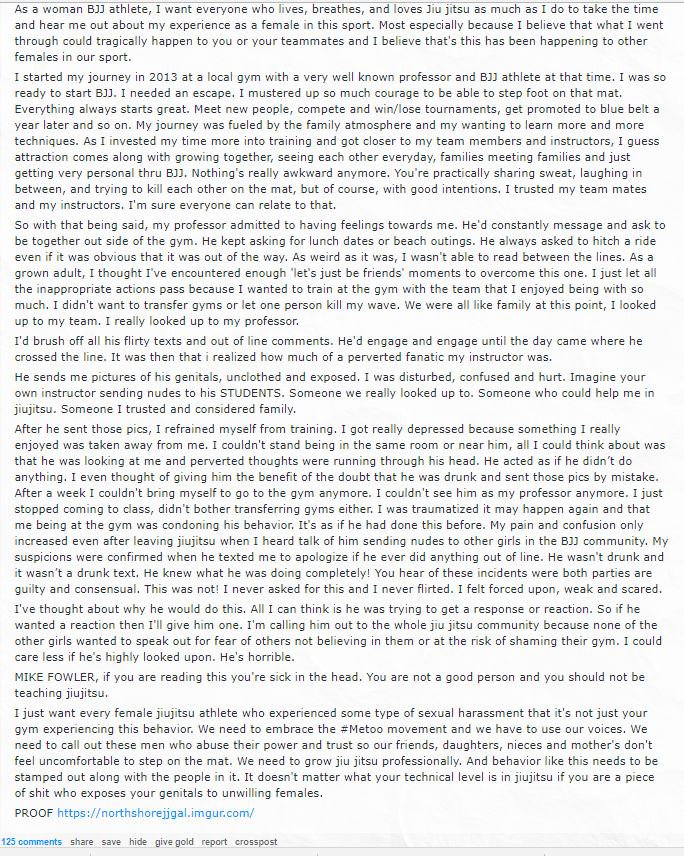
This is the straw that broke things for us here. Within the last 24 hours we’ve been contacted about this multiple times. According to a post on Reddit, which originally included the pictures in question for all to see, the noted BJJ black belt and instructor sent unsolicited nude photos of his genitals to at least one of his students. The photos in question have since been verified as his, both by multiple people and by Fowler himself, who has apologized.

Here’s the original post: (no, we’re not including the images):

Reddit post about Mike Fowler
Click for full size

The reason this is especially heinous is because Mike Fowler was as far as everyone was concerned, until yesterday, one of the good guys. He put his livelihood and role in the BJJ community on the line to stand up to Lloyd Irvin, his former instructor, going so far as calling him a “bully”, a “sexual predator”, and flat out “a rapist”. Fowler faced the threat of a lawsuit from Irvin over this. (For those of you outside of the Brazilian Jiujitusu community, Lloyd Irvin is a major figure in the sport, and has a chain of sexual allegations against him and his students, including the fact that he was present at a gang rape.)

But…

This is not about Mike Fowler, this is about YOU

These accusations seem to be coming rapid-fire the past few years, and they do not seem to be slowing down. The number of messages we’ve received alone is infuriating, and frankly we’re fucking sick of it.

So here’s the plan:

Brazilian Jiujitsu and the Martial Arts in general need to put on their Big Boy pants, and fucking keep them on

The dojo is not your dating pool

Every respectable industry has explicit rules about teachers or instructors or coaches having personal, romantic relationships with their students. And for those whose skulls have been bounced off the mat too many times, the reason for that is simple:

Instructors are in a position of social power, of psychological power, and even physical power over their students. There is not a relationship of equality in play here, consequently, there are opportunities for those with less self control, less moral fiber, less goddamn honor, to take advantage of the situation and use that inequality to give them an edge in breaking through the barriers of consent.

Instructors are in a position of social power, of psychological power, and even physical power over their students

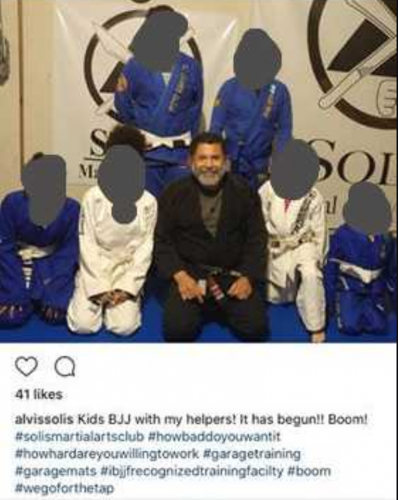
And that’s the BEST CASE SCENARIO. The worst-case is straight-up Larry Nasser, Jerry Sandusky, molestation and rape. In between are all sorts of shades of gray, such as the accusations of “Grooming” underage students by BJJ instructor Alvis Solis to be future sex partners.

By the way, Alvis Solis is still teaching people, including children, out of his garage:

Alvis Solis
Apparently the word hasn’t gotten out enough about this sleezebag…

With a BJJ school in nearly every neighborhood nowadays, the sport needs to get its shit together. The women and children who train and compete in it deserve better than to have to wonder if the person they’re trusting with their bodies wants to stick his penis in them. If BJJ is your profession, then grow the hell up and act like a professional.

Blurred Lines
This, but in a gi – blurred lines don’t belong in BJJ

The No-BS Guide to Gun Control and the Second Amendment

Photo by Sara Liberte.

So, let’s start with an agreement. Before you rush to the comments section to whine, cry or blather on about the article let’s at least agree that you will read this in its entirety. You won’t skim, you won’t stop reading at the first hint of disagreement, and for the love of god you won’t share based solely on the headline. 

Are we in agreement? Let’s begin.

In the wake of tragedy, there exists an urge to do something. Mass shootings give rise to the rare occasion of a terrible problem with an ostensibly simple solution. The solution to curbing firearm-related deaths, however, is so charged with emotion that reasonable discourse is seemingly impossible. That, unfortunately, will likely never change. It seems like neither side is willing to extend an olive branch, to communicate with the other.

Well, let Bullshido be the olive branch.

Gun Control – For Starters

So how do we tackle the problem of firearms-related deaths? Where do we even start? It seems in the wake of unimaginable horror, our collective focus fixes upon prevention of that horror. These mass shootings, however, account for a small fraction of firearms-related deaths. Suicide, criminal homicide (of the non-mass shooting variety) and accidents account for almost the entirety of annual firearms deaths in America. 

Yet, on the onset we must address these mass shootings. As a firearms enthusiast, I can feel secure in the protections afforded me by the 2nd amendment. This security, however, will not always exist. Columbine happened 19 years ago. The “lockdown” generation (credit to one of my Facebook friends for bringing that term to my attention) will become State and Federal legislators, politicians and judges. Much like how Generation X and Y have started paving the route to marijuana legalization, so too will the “lockdown” generation hail in the death of the 2nd amendment.

How can we avoid this? Easy. Firearms enthusiasts need to be reasonable, and reasonableness starts with accepting that the meaning of the 2nd amendment is not limited solely to the words in the text. The 2nd Amendment, like all fundamental rights, is subject to “reasonable restrictions”. Firearms enthusiasts have the ability to help define reasonableness, yet too often armchair justices refrain from any reasonable discourse. Dying on the cross of “shall not be infringed” will hasten the result these enthusiasts purportedly seek to avoid. Firearms enthusiasts must compromise, and that compromise means we must stop painting ourselves into corners. So too must gun safety advocates be willing to accept the inherent protections of the 2nd amendment, and the very real reasons Americans choose to own firearms. There are significant reasons why reasonable firearms owners are against additional restrictions, particularly the fact that a great deal of gun crimes are never prosecuted.

So, let’s talk about compromise. Let’s talk about reasonableness. Moreover, let’s compromise and let’s be reasonable.

In the wake of mass shootings, there are always calls to:

  1. Eliminate the “gun show loophole”
  2. Increase the age of firearms purchase
  3. Mandate mental health checks into the firearms purchase process.

Eliminating the “gun show loophole”

AR-15s at a Gun Show
AR-15s for sale at a Gun Show

The infamous “gun show loophole”. This is a scary term for a relatively innocuous occurrence, where a private party sells a firearm to another private party. Typically, all firearms sales must go through a federally licensed firearm dealer (an “FFL”).  Further, if an FFL is selling firearms at a gun show, they must still run a background check. Let’s not forget that roughly 2% of criminal firearms are purchased at gun shows.

Private party sales, in many states, do not require background checks. While this may sound terrifying to some, imagine this scenario: your Father/Grandfather/Mother/Grandmother wants to sell you their firearm. Are you still frightened? 

Gun safety advocates argue that this allows criminals to circumvent NICS (the background check database that all FFLs must check before completing a purchase). This contention may or may not be based in fact, there is conflicting evidence that reasonably supports, and refutes, that position. But why is it even an issue? It is the barest of inconveniences to drive down to a gun store and have an FFL run background. It costs around $25.00. 

As firearms enthusiasts, let’s extend an olive branch and support legislation that requires all private firearm transfers – save for inheritances – to be properly transferred through an FFL. This is a measure that results in the barest of inconveniences for us, and eases the minds of our compatriots. (If you are thinking the words “slippery slope”, please click here.)

Age of Purchase

Children with guns
No.

The recent tragedy may likely have been avoided had the minimum purchase age been 21. While staunch libertarians will likely balk at the idea of waiting 3 additional years to exercise a constitutional right, this is still a reasonable compromise. It would impact a small minority of firearms enthusiasts. Disallowing teenagers to purchase firearms will not hail in tyranny. The irony of being too immature to drink, but mature enough to own a firearm is not lost upon us. To be honest, the irony of being too immature to drink but mature enough serve in the military is not lost upon us, either.

Unfortunately, such ironies must be tolerated in a civil society. This is a reasonable restriction on the 2nd amendment. Owning a firearm is an incredible responsibility. If society has reached the consensus that those under 21 are too irresponsible to consume alcohol, it’s reasonable to restrict all firearms purchases until 21. This would still allow the transfer of firearms between parents and their children, while keeping people like the Parkland school shooter from purchasing firearms.

Mental Health Checks

Duke Study Firearms Suicide
Duke University Study on Firearms, Suicide, etc. Link.

So here we are – mental health checks. One side rallies around the idea of it being a “mental health issue; not a gun issue.” The other says that we should implement mental health checks into the firearms purchase process. Another offshoot is the idea that government lists, such as the “Do Not Fly” list, should restrict purchase. 

First, “mental health” is a complicated beast. There are a myriad of complex and complicated disorders that vary in presentation between individuals. Banning individuals with particular diagnoses would unfairly impact the rights of millions of Americans – everyone from the teacher with ADHD to the veteran with PTSD – and would be wholly unconstitutional. This does nothing, of course, to discuss the inherent issues with forcing an individual to undergo an invasive examination for the mere purposes of exercising a constitutional right. If an individual is adjudicated mentally incompetent, however, that information must be reported to NICS. [Side note: NICS is horrifically underfunded, and a great deal of tragedies would be avoided by reforms to both reporting methods and the system itself. That, however, is an article for another time]

As reasonable people, we can agree that the right to bear arms is a constitutional right. It shouldn’t be a stretch to agree that all constitutional rights are equal. It is, after all, in the Constitution. The 2nd amendment is afforded the same protections as the 1st and 4th amendments. A handy little test we can use for the institution of a new policy is to replace the 2nd amendment with the 4th amendment. For those of us that did poorly in social studies, the 4th amendment protects you from unwarranted searches and seizures. It is your right to privacy from the government. We all like that, right?

So, do we want to have our 4th amendment rights – the right to be free from unwarranted searches – restricted based on a subjective opinion and/or a secret government list? As reasonable people, we can all agree that would be ludicrous. Truly, the notion of a Federal Agent snooping through our things because of an arbitrary and secret proceeding would be awful. 

The restriction of a constitutional right, without due process of law, is simply a compromise that is unreasonable. 

The Big Three

Its important not to lose the forest for the trees. Firearms deaths due to suicide, criminal homicide (not including mass shootings), and accidental discharge are every day tragedies that require attention.

Suicide

Firearms and Suicide
Despite what the M*A*S*H* theme would have you believe, suicide is not painless

Of the roughly 30,000 gun deaths in this country, roughly 2/3rds are the result of suicide. This point is worthy of dwelling upon – one side will say that people will find ways to effect their desired ends, another will disagree.  In America, 50% of suicides are committed using a firearm. There is some evidence that supports efforts to reduce suicide by removing easy means. In the U.K., the preferred method of suicide as by suffocation via coal burning oven. After the U.K. banned coal-burning ovens, suicide rates dropped precipitously.

We need to encourage access to mental health resources. It is not enough to establish resources for individuals in distress; we must ensure that those who are at risk are actually aware of them. Crisis lines and suicide lines, lifesaving though they are, are simply not enough. We need to ensure those experiencing a crisis have more than just a phone number to call; it is imperative that treatment is available.

Criminal Homicide (not including mass shootings)

Chalk Outline Crime Scene
This is a generic picture of a crime scene. In case you thought it was street art. Which in a twisted, postmodern sense, sure, it could be. I guess.

The vast majority of the remaining 1/3rd of American gun deaths are due to criminal homicide

Save for specific measures, such as prohibiting felons and domestic abusers, the reduction of criminal homicide is a difficult beast to tackle. Some data supports the idea that gang activity accounts for a significant portion of those homicides. A reasonable assumption is that these homicides are the result of disputes regarding a wide variety of possible things, from territory to drugs.

Let’s start with a hypothetical. You are a manufacturer of gears. You verbally agree to give your neighbor $499 worth of gears. Your neighbor agrees to sell the gears and pay you with the proceeds. Your neighbor takes the gears and sells them, but decides to not pay you for the gears! 

What do you do? Easy, you sue. Well, maybe not over $499 worth of gears, but you get the picture. You could sue, however, because the Statute of Frauds would not bar enforcement of the contract! [Sorry, this is an article about guns, not contract law.]

Now instead of manufacturing gears, you grow marijuana. The above scenario plays out and guess what – you cannot sue for breach of contract. Any contract with illegal subject matter is not enforceable by the courts. Rather than suing in court, and allowing the government to enforce your contract rights, you must take up the mantle yourself. The problems become apparent, as do the solutions. Legislators should examine the social utility of opening up non-violent dispute resolution to individuals engaged in illicit business. After all, the IRS doesn’t care if you rob people, so long as you report it on your taxes.

Now, the above will necessarily lead to the end of the War on Drugs. Everyone but Jeff Sessions can agree that’s probably a good thing. We can redistribute the funding to focus on firearms crime prosecution, which is sorely needed. Intentional straw purchasers, felons attempting to purchase, and those who use firearms in furtherance of dangerous crimes should receive hefty sentences. Perhaps by making the consequences of using a firearm illegally more severe than the consequences of not using a firearm illegally, we can reduce the rate of criminal homicide.

Accidents

A Christmas Story AR-15
“You’ll shoot EVERYONE’s eyes out…”

The 3rd leading cause of firearms deaths are accidents. These can range from an individual cleaning their firearm, to a child gaining access to a firearm. Either way, these are entirely preventable tragedies.

In elementary school, we listened to Eddie Eagle, who told us to stop, don’t touch, leave the area and tell and adult if we ever encountered a firearm. I don’t believe that is enough. Firearms are incredibly dangerous if mishandled, and the great deal of television, movies and video games do not portray that. Imploring children to go against their natural instincts makes as much sense as only teaching abstinence in sex-ed. Children should be taught how to safely handle a firearm in middle and high school by a competent instructor.

What’s wrong with this? A police officer could very easily bring in inert firearms (firearms with the firing mechanism and barrel welded shut) and explain the mechanics of the firearm, the consequences of misuse, and the most basic concepts – don’t point it at anything breathing and don’t put your finger on the trigger – to children. Parents would be able to opt their child out, of course, but imagine if even one child that grabs hold of a firearm remembers to keep his finger off the trigger, rather than on the trigger? Wouldn’t that life, alone, make the idea work? That, in addition to encouraging safe and proper firearms storage practices, may prevent a significant number of deaths.

So there we have it; three feel-good solutions and three goal-oriented solutions.

Where do we go from here?

Before you succumb to media-driven hysteria, keep in mind two fundamental points:

1. The 24 hour state of television and Internet news not only requires constant, explosive content to attract eyeballs and clicks, the media is almost entirely for-profit and has a financial incentive to keep you terrified, and hooked to your screens; large or small.

2. Overall violent crime has been plummeting since the early 90s, and it drops further ever year. As an American living in 2018, you are likely the safest you have ever been in your entire life.

Pinker Violence
Harvard Professor Steven Pinker, author of “Enlightenment Now: The Case for Reason, Science, Humanism, and Progress”


Derek Debus is a former Marine infantryman and Combat Instructor, professional firearms instructor and law student, though he does not speak on behalf of any of those groups. He can currently be found at [your mom’s house]

Featured Photo Credit: Sara Liberte.

It’s Perfectly Legal to Kill Someone as Long as you Use This Specific Weapon

0

Legal in all fifty states, and nearly every country on Earth!

Attention psychopaths and sociopaths: have you ever wondered what it’s like to kill another person, but are worried about those pesky legal consequences that might ruin future plans? Have you wanted to kill thousands of people? Well there’s great news: one method of killing other has been completely legal throughout all of Human history.

Are you ready to find out? Just keep reading through this 20 page slide presentation

we’re kidding. You’d be within your rights to want to murder us for that. Anyway, here’s the answer:

It’s Bullshit.

Yes, it is perfectly legal to kill someone using bullshit.

“WTF?”, you grumble to yourself about wasting a click, and look for the back button. Just wait though, we’re gonna ‘splain.

No, Seriously

Imagine you’re in an Otis Redding mood and head down to sit down at the docks and stare at the water, contemplating existence, trolley problems, and what-not. Just then you hear thrashing and gurgling below—someone’s drowning.

Drowning WikiHow
“WORLD STAR!”

Immediately you spring into action. Leaping to your feet you heft an object in their direction, shouting “here, this will save you!”.

It’s a boat anchor.

They drown.

Of course they do.

But hey, you “believe” anchors save people from drowning, so it’s all good, right?

Of course it isn’t. Right?

Let’s tweak the scenario: your mother is diagnosed with pneumonia. She’s having trouble breathing to the point her lips are turning blue. Instead of offering her a ride to the emergency room, you offer her a Homeopathic remedy. How about this one? You’re close friends with a billionaire tech mogul who comes down with one of the few treatable forms of pancreatic cancer. You encourage him to try enemas instead of going to a real doctor.

Steve Jobs Cancer
Heal Different™

Or, you’re the parent of an infant who requires a blood transfusion to survive, due to a defect in the baby’s ability to produce properly-formed erythrocytes capable of delivering adequate oxygen. You refuse blood products and insist on curing it with prayer. 

At this point you’re thinking “but in all these scenarios, the people genuinely believed those things would help… even if they didn’t“. Sure.

But can you prove that? In every case?

It is perfectly legal to kill someone with Bullshit

Now what about this one:

A medical doctor knowingly falsifies information to support the idea that vaccines actually cause diseases. This leads to hundreds of thousands, if not millions of people being reluctant to vaccinate their children out of stark, emotional, irrational terror. Consequently, diseases which were once all but eradicated worldwide, start popping back up in small, but growing clusters around the least-educated parts of your own country.

Andrew Wakefield
This is disgraced former doctor Andrew Wakefield. He published fraudulent research stating that Autism was caused by the MMR vaccine, causing fear and panic among parents, leading to a whole generation of under-vaccinated children. We’re not saying Andrew Wakefield is a murderer, let alone a mass-murderer or guilty of genocide, we’re just saying that if that was his secret intention all along, he totally got away with it.

Most of the people who were and are afraid of vaccinating there children do not know Andrew Wakefield’s name, much less his fraudulent legacy. They just know the fear he put into them, which took advantage of the innate fear every loving parent has of doing accidental harm to their child.

Related

And then there are these motherfuckers…

David Wolfe and Food Babe
Hi, I’m famous for being the naked guy on a reality show about weirdos. And my background is in IT and marketing. We’re nutrition experts!

There’s no paragraph about David Wolfe and Vani “Food Babe” Hari, we just wanted to remind you that they’re both motherfuckers.

The Takeaway

We’re not advocating for the legal system to get involved when Grandma offers you a Hot Toddy for your cold symptoms or when your Hispanic mother-in-law advocates rubbing a commercial menthol gel on any-and-every body part to cure any-and-every thing that ails her grandkids.

But when grossly unqualified people advocate specific courses of medical treatment, including diets, people fucking die. If you wouldn’t ask your yoga instructor for advice on fixing your air conditioner, why the hell would you let them chime in on how to fix a complicated medical issue?

And what’s worse, where the hell would they get off providing anyone advice on that front in the first place? So sure, there’s probably not a case of someone deliberately killing another person by giving them bullshit medical or dietary advice, but there sure is an evidence of people pretending to be an expert on medical issues, causing other people to die.

And who’s to say none of them actually, secretly, sociopathically, were happy about it?