“SAMBO” Steve Kopefer is one the most notable icons of this Russian martial art in the United States but for the past several years has established himself as an authority on fighting in films and TV, working behind the scenes on some of the most exciting movies and shows to hit the screen. He shares his time and insight with us.
If this is your first time on Bullshido (or if you just have a serious issue with retaining what you’ve read here for the past couple of decades due to fully-consensual head trauma like many of our old school members) we’ll preface this with a brief explanation that part of our shtick is explaining how to defend yourself against bullshitters, grifters, and frauds, using martial arts analogies that are more readily grasped by our audience than dense academic language ordinary folks will TL;DR the F out of.
Christ, that’s an ugly paragraph/sentence, but it’s the one you savages deserve. I don’t pretend to be Christopher Hitchens and both my liquor cabinet and esophagus thank me for that. Anyway, explanation complete, moving on.
Firehosing
Much like a nematode that is so functionally self-contained that it can literally go fuck itself, (offending a swath of science twitter when this is brought up) this term is almost self-explanatory. But if “almost” was good enough we wouldn’t be here, so let’s break it down with thick crayons.
You may have heard of the debate tactic called “Gish Gallop“. In fighting, it’s peppering the other guy with a bunch of rapid, but weak punches. In gamer terms, it’s a Zerg rush, sending a bunch of trash units at the enemy to overwhelm them. It’s a “death by a thousand cuts” sort of strategy, except that 995 of them aren’t even really cuts and the rest barely even qualify as English.
Essentially someone does this because their argument sucks, or they suck at arguing and know their target audience is stupid, so they resort to foaming at the mouth and hoping that audience mistakes their symptoms for profundity while simultaneously baffling their interlocutor.
Now imagine if this type of bullshitting is done on the scale of an entire society.
Firehosing takes advantage of the fact that the human mind can only process so much information, let alone obvious lies and bullshit, before it all starts blurring into a nebulous mass of vague discomfort. The term was coined a few years ago by Christopher Paul and Miriam Matthews to describe the tactics of a certain state actor we’re all familiar with by now as a threat to Western Democracy.
(If you’ve never seen this, stop what you are doing and watch it. Words cannot describe the experience of seeing a German disco band, pretending to be Mongolians, singing about Russians).
But the use of this bullshit tactic isn’t limited to kleptocrats, autocrats, or kakistocrats. Dr. Lucky Tran, a noted biochemist and science communicator, explains that it is also being used by conspiracy theorists and anti-vaccine activists to muddy the waters about well-established science behind vaccine safety. This is because, as the saying goes by LITERALLY HITLER, if you repeat a lie enough it becomes true; at least for some people.
It’s to rob facts of their power. Firehosing inundates us with so many wild opinions that it becomes exhausting to continually disprove them. In this scenario, reality is reduced to positioning and who can sell their position best.
There’s a strong chance at least one in three people reading this piece is going to think “well gee, why don’t you just cut off the water, dumbass?”. And you’d almost be right, depending on how you go about it. While it would certainly be gratifying to “cut off” all bullshit, if there was a practical solution for doing so without giving way to even more insidious forces such as, say, outright tyranny, we would have already found it.
A free, and unencumbered Press, is essential to any system in which individuals ostensibly exercised an informed vote. And as anyone who has been even paying half attention to the past few years should be aware, calling something bullshit, or more specifically “fake news”, is a key tactic of both those who want to spread bullshit themselves, and even more dangerously, those who want to believe that bullshit.
The sad reality is that there is no single form of defense against this. Even more sad is that the average person is barely capable of gleaning nuggets of information out of the raging river that is the modern information and media complex, between mainstream and alternative news sources, podcasts, YouTube videos, Facebook posts, and water cooler chit-chat. And what’s utterly disheartening, enough so to make you want to fuck off and buy a sheep farm in Iceland or something, is the fact that it is only going to get worse in the coming years, because the people prone to do this, now know for sure that it works.
Protect yourself at all times, even if it might not do a lot of good.
(If you’re bummed out, go back and watch the video. Vodka is suggested, but optional.)
Let me get straight to the inevitable point of this piece. The first Presidential debate of the 2020 election cycle was an unsalvageable mess that managed to completely devalue the words “presidential” and “debate” at the same time. Debates, by their very definition, are an exchange of ideas structured around two opposing contestants. In the case of a presidential debate, the contestants are there to represent their candidacies in opposition to each other so the viewing public can decide which presents a more compelling prospect.
In practice, what we have come to expect is a televised contest to see which contestant offers the most delectable sound bites and/or commits the most/least egregious gaffes and faux pas. It is a far cry from Socrates vs. Plato on its best day, though the electorate usually gets some sort of policy or platform information delivered in an environment where it can be challenged.
What we got this time was…
I don’t know what it was. It was not a debate in any real sense of the word.
What Went Wrong?
This is a question with many answers. Not because it is a conundrum complex and nuanced, but because virtually nothing went right. The most critical failure, and the one from which the entire dumpster fire spawned, was that one person entered the arena with no intention of debating at all. Rhetorical combat only has value when the combatants agree to present their case while letting the other side do the same. Without an equitable format and the honest participation of the debaters, the debate has no value. It’s just two dogs barking at each other across a fence.
Since time immemorial, debates have been built around structures and formats that facilitate the fair exchange of ideas between the participants. For this presidential debate, candidates were allotted two minutes of uninterrupted response time for each question. A period of open discussion would follow the answer period whereupon those responses could be dissected and vivisected in a less structured manner. It is not a new or uncommon format and many debates have employed versions of it in the past. Both candidates agreed to this format in writing prior to the start.
The reasons for employing this system seem obvious. It allows for two vastly different forms of idea exchange while challenging each debater to defend the presented ideas from the other in real time. Prepared answers and talking points are necessary for concise messaging, but at some point, the debater will have to defend those without help from a script or cue cards.
On paper, it was a fair compromise that allowed each candidate some chances to do what they do best. Biden performs very poorly when he is speaking extemporaneously but seems to do fine when he has a script to work from. Two minutes to answer a question with his prepared remarks favors his method and gives him the chance to speak to his platform clearly. Open discussion (whatever that was supposed to mean) gives Trump the opportunity to work his and his opponent’s positions over in an unstructured way that seems to speak to his supporters. Both parties agreed to the rules.
The problem with having rules without rule enforcers is that they rely upon the will of the participants to follow them. We all know what happened next. Any and all adherence to this format was abandoned after the first question. Trump simply could not let Biden have his two minutes of uninterrupted answer time. This failure rests almost entirely on Donald Trump, as well. Biden certainly interrupted Trump’s allotted response time more than once, but the best current count of allotted time interruptions is from Slate.com who scores 51 interruptions from Biden against Trump’s 128. Most of Biden’s infractions occurred well after it had become clear that no one was going to follow or enforce these rules in any capacity. All this means is that Trump was successful in pulling Biden down to his level for at least a little bit. What no one can deny is that the debate ceased to be a debate. The collapse of discourse came early, snowballed fast, and remained stubbornly unrecoverable.
Maybe this guy should run for President?
Which brings us to the moderator, Chris Wallace. Did he do a bad job? It’s hard to say, because without a cattle prod, squirt gun, or sharp stick, it is not clear that any moderator could have stopped Trump from running roughshod over the debate format. Joe Rogan recommended that the next debate should be moderated by UFC veteran referee “Big” John MCCarthy and I’m embarrassed to say that the idea is starting to sound like it has merit. More than once, Wallace had to remind Trump that he was the moderator and that you were supposed to let the moderator finish the question before talking. At one point Wallace actually said to Trump, “You’re debating him (indicating Biden), not me. Let me ask my question.” At least 25 times Wallace reminded Trump of the debate rules and that Trump had agreed to them. The debate was only 90 minutes long. That is one reminder every 3.6 minutes.
Nothing worked, as we all saw. Once the format of the debate, and let’s be honest, the concept of a debate had been abandoned, there was nowhere to go but down. Trump quickly moved on offense, capitalizing on a clearly rattled Biden’s attempts to do, well, anything. Biden soon fell into the trap of ad hominem, referring to Trump as a “clown” at one point. The real breaking point came when after yet another interruption of his allotted two-minute answer time, the obviously frustrated Biden implored, “Will you just shut up, man?”
Trump did not shut up. More concerning to the moderator and concerned voters, it appeared as if he could not shut up. The most basic levels of impulse control were nowhere to be found in Trump’s performance. His attack was relentless, overwhelming, and immune to anything resembling self-awareness. Both Biden and Wallace were powerless to control Trump’s need to dominate 100% of the stage and airtime. His interruptions were rarely salient criticisms, either. He made childish quips, exaggerated sighs, or tried to change the question that had been asked. Author and psychologist Joshua Coleman commented in an interview with The Atlantic that Trump’s constant interrupting “demonstrates a disinterest in responding to what is being said” and is “more an act of domination than healthy dialogue.” Therapist and marriage counselor Ian Kerner remarked, “Biden turning away from Trump to speak to the American people reminded me of when patients turn to me because they can no longer converse with their partner.”
None of what went on in that debate constituted an exchange of ideas or the examination of political positions. Trump deliberately sabotaged any chance of interesting dialog by preventing dialog from occurring whenever it was not him that was talking.
This was on-brand for Trump, however, and his core followers seemed to feel this constituted a victory. There is something to be said for that. Depending on how one defines victory, Trump may have won that debate simply by behaving the way his fans want and expect him too. His irreverence for political theater and the proclivity towards being a showman are a big part of what his base finds appealing. A more dignified, more respectful Donald Trump may have been worse for his campaign than the one we saw during the debate. That would be a significant departure from the Donald Trump that got elected last time around.
For his part, Biden never really got a word in edgewise or otherwise. Tactically speaking, bulldozing a candidate characterized as “Sleepy Joe” may have been an inspired bit of strategy. If Joe had been befuddled or shown weakness, the image of the doddering old man might have been further cemented in the minds of those watching. This put Biden in a precarious place. If he descends into the muck with Trump, he risks losing to Trump’s superior skills in the arena of being a jerk. If he tries to stay above the fray, he looks weak or scared. Biden elected a third option, which is to dip one toe into the mud while clinging to the podium with as much dignity as he could salvage. As has become a common refrain with American politics, this merely served to highlight that the Democratic candidate is only “better” than the Republican candidate because the republican candidate is “worse.” One can switch the positions of the parties in that statement at will without changing any salient facts, and that should make you sad.
By the time the house lights came up at Case Western University, the American people had been served what can only be described as a disaster of a presidential debate. In truth, no one in good conscience could call what happened a “debate” with a straight face. It was a schoolyard shouting match between a bully and jock over which one should get to date the prettiest cheerleader. There were no winners in the debate, only losers. The American people being the ones to lose the most.
Objectively speaking, further debates are in real danger. If debates are going to have any value to the electorate, then some enforcement of the rules will be necessary. Otherwise, I can just watch my children argue over the last red popsicle for ninety minutes and get the same experience. Modern technology offers us numerous solutions to the problem of someone incapable of shutting up for 120 seconds while someone else is answering a question. Then after the time is up, cut ‘em loose on each other and see what happens. It is not a complicated process.
Locking candidates into a soundproof booth and shutting off their microphones should not be necessary. Unfortunately, it may very well be our new reality. Whether it is shrewd strategy or pathological assholery, trying to debate with Donald Trump is like playing chess with a pigeon. No matter what you do, the bird is just going to knock all the pieces over, crap on the board, and then strut around like it won anyway. If we cannot get a real debate out of a candidate, there is no reason to have a debate at all. Furthermore, if you watched that debate and feel like your candidate “won,” I recommend you drink a tall glass of good bourbon and then punch yourself in the face until either that feeling passes or you die. The future of our republic may depend upon which one occurs first.
Engineer and author Andrew “Scrapper” Vaillencourt comes back on the show to discuss the terrible state of everything, recent shooting incidents, and how to solve the damn problems instead of just arguing about them.
We all think we are pretty smart, don’t we? If you are reading this article and think you are of above-average intelligence, raise your hand. I promise you, nearly every person (often every person) will stick a hand in the air without hesitation. Some people will raise both hands, and that is a great way to tell who is not of above-average intelligence.
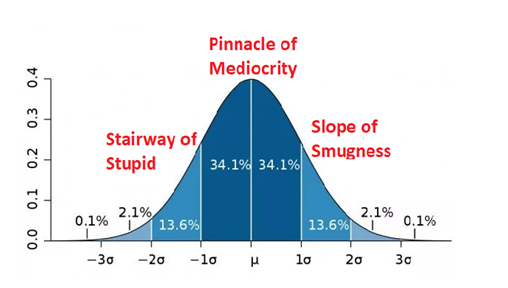
In any randomly selected group of human beings, we should expect a bell curve of brainpower ranging from window-licking imbecile to MODOK-level super-genius. Here’s a chart to help you visualize.
Half of the people in any population will be either sliding down the Slope of Smugness or climbing the Stairway of Stupid at any given time. A large portion of us are still hanging out at the Pinnacle of Mediocrity and high-fiving each other over all the folks still coming up the hill. That is how the concept of “average” works. It can get more complicated than that, but at the core, the concept is quite simple:
Half of us are not nearly so bright as the other half, and very few of us are as smart as we think we are.
Statistically speaking, you are probably not on the slope of smugness. Statistically speaking, very few of us are. Nevertheless, a great many of us live our lives firmly entrenched in the belief that we are smarter than most of the folks around us. What does this have to do with Facebook groups, I hear you ask? Very little at first. Stay with me.
Springes to Catch Woodcocks
Underneath all the things a social media platform does is a central concept. They need you to spend as much time on the platform as possible. They sell advertising, and for advertising to have value it must be observed. All social media sites are designed to keep your eyes on that screen for the maximum amount of time in order to maximize the value of the ads they sell. That’s it. That’s the whole thing. You don’t need to watch Netflix’s terrifying “The Social Dilemma” now. I just told you everything you need to know about social media.
Everything Facebook or Instagram shows you is an attempt to hold your attention for an extra few seconds or to keep you from logging off. They aren’t even creating the content that’s being used to hook you. They are simply showing you something someone else made (like this article for instance…).
Facebook (or Instagram, or Twitter…) knows what you like. They know what articles you click on and what pictures you stop scrolling to look at. They will feed you those things and anything remotely like them in a never-ending effort to keep your eyes on the screen and the ads in front of you. And do you know what seems to work really well?
Groups of like-minded people who say things you already agree with! The algorithms figured out early on that when presented with content from like-minded groups, people hung out longer. If you “like” a communist improv comedy group centered in your city, you can bet your last BitCoin that Facebook is going to show you as many similar groups as it can. The more groups you “like” or join, the more accurately it can predict the content that keeps you clicking. By itself this is not a bad thing. Of course, we want to see the content we like and from people we agree with.
But what about groups you disagree with? What about all the content that does not align with your own feelings and biases? What happens to that stuff? Your social media narcotic of choice is certainly not going to show you that stuff. That stuff makes bad feelings of confusion and sadness, and we can’t sell poorly made merchandise from Asian sweatshops to people who are confused and sad. Once again, this is not the bad part. This is just good business sense at work. Where things get dark is how these content creators have benefitted from the social media business model.
Springe means “Trap” (Enter the Echo Chamber)
When you no longer see any content that challenges your worldview or beliefs, it gets very easy to forget that other worldviews and belief systems exist. Worse, when all the content you consume is heavily biased, you are not getting an accurate picture of the system you espouse and its opponents. You are in an echo chamber. A big space full of people who think and believe the way you do. Inside the comforting shell of shared ego, your only job is to repeat the things everyone already agrees upon ad nauseum. There is no meaningful discussion in an echo chamber. Just a fashion show where each member trots out their gaudiest and most festive version of the groupthink to stimulate the adulation of the hive mind. Every post, every “like,” every share, reinforces the system without challenging any of it. It is addictive, too. Just like a slot machine, you keep pulling the rhetorical handle hoping for that nice little squirt of dopamine in the form of a smiley emoji. Every time you see yet another person telling you that you are right and that you belong to a group of other right-minded people, the system strengthens itself. With every errant click the minds of those trapped inside become more and more resilient to actual progress.
If this was a Marvel Comics fan group, no harm would be done. It is an objective truth that Marvel is WAY better than DC, anyway, so what’s the big deal? Often, the echo chamber is social or political. This is less amusing. For fun, I took a snapshot of two of reddit.com’s politics pages.
The one on the left is Reddit’s r/Politics front page, just as it is presented to me. The subreddit is described as follows.
“ /r/Politics is for news and discussion about U.S. politics.”
The other is r/neutralpolitics, which is described thusly:
“A heavily moderated community dedicated to evenhanded, empirical discussion of political issues. Based on facts and respectful discussion.”
Here is what it gives me, side-by-side comparison:
One of these is an echo chamber. You pick.
Reddit is a perfect example of how invisible internet points generate echo chambers. Most subreddits are, by their very definitions, echo chambers. By introducing the concept of “upvotes” and “downvotes,” Reddit has added a competitive aspect to pedagoguery the likes of which the world has never seen before. It’s now quite literally a game to see who can score the most points.
Not all Bait is ClickBait (Confirmation Bias)
Confirmation bias is the most insidious of the logical pitfalls. It is typically easy to spot in others but nearly impossible to see in ourselves. Literally, it refers to our deep-seated tendency to give extra credence to ideas and information that reinforce conclusions we want to be true. It is why so many ineffective martial arts masters insist that their art is “too deadly” for modern MMA competition. Rather than test their system in a fairly objective environment, it is enough for them to note the rules and the safety measures and declare MMA “too limited” to truly express their prowess. Confirmation bias is why anti-vaxxers continually reference one bad study from a disgraced doctor that has been debunked literally hundreds of times.
Look what happened to beloved actor James Woods. So eager was he to point out (what he believed was) an obvious attempt at media manipulation that he forgot to check whether or not there was any occurring.
It would not have taken much time or effort for Mr. Woods to dig deep enough into the picture to realize that a map showing the locations of American wildfires would exclude wildfires outside of America. But his confirmation bias was so strong it left no room for any doubt that the thing he had already decided was happening had happened. Climbing up the Stairway of Stupid is tough enough, James. Don’t make it harder than it needs to be.
Silly alt-right guys, amirite? Thank goodness that the progressive folks are immune to…
Oh crap.
Remember when Amber Heard revealed how physically and emotionally abusive Johnny Depp was? Do you remember that these accusations were met with very little scrutiny and ended up costing Johnny the next “Pirates of the Caribbean” movie? The ad-bots and click-farmers went nuts because the story was topical, titillating, and oh-so-goddamn clickable. The subreddits were humming with activity.
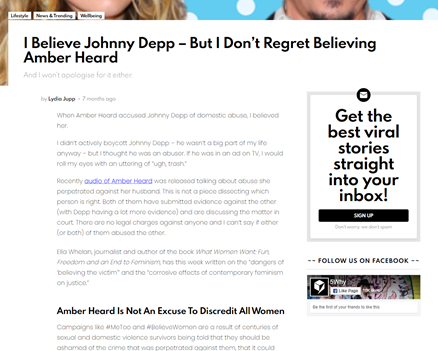
Of course we all know now that she was the abuser and her accusations were yet another form of psychological torture heaped onto the physical abuse and gaslighting she was already doing. But confirmation bias drove all objective reason from the minds of those who wanted to believe the story. Vox wrote a scathing rebuke of those who doubted her claims. The Guardian compared her to Charlotte Bronte for her bravery and phoenix-like ascension from the depths of his brutality. Then there was this:
The picture above brazenly declares the author’s not-wrongness even as it acknowledges just how wrong she was. She is insisting that her harmful ignorance and confirmation bias is a good thing.
As James Woods and Vox have demonstrated, ad-driven media is guided by AI that does not care where you fall on the bell curve. It just wants your eyes on the screen as much as possible. No one at Twitter cares if you are smart or stupid. Stop scrolling and click stuff, revenue-monkey. Daddy needs more bananas.
The algorithms have learned that confirmation bias gets you to click on content, and well-curated content that confirms what you already feel keeps your attention glued to the screen. The algorithm is not evil. It is entirely neutral on the topic of human progress. It will show you flat-earth conspiracy groups all day long if it means you will keep clicking that stupid “like” button.
Escape
Good job agreeing with me, me.
There is no easy way to say this. Confirmation bias is the bait, and an echo chamber is the trap. Once in, getting out is very hard.
The first step is to accept that you are a victim of your confirmation bias. You cannot stop it. You cannot even see it half the time. The only way to kill it is to get out of your echo chambers and challenge your own beliefs. A lot. It will hurt, because confirmation bias does not let us admit we are wrong without a fight. Outside of your echo chambers, you might find some very well-informed people who are quite certain of your wrongness. Most of us will argue from a place of ego when this happens. The fight stops being about what is true, but rather who is not wrong. It is an artifact of your ego and it is making you dumber.
No one wants to look foolish, so we fight against facts that reveal our foolishness. Unfortunately, this only compounds the foolishness. There is nothing more foolish than having to plug your ears and scream “I can’t hear you!” when the crushing fist of objective reality smashes your poorly constructed belief system in its stupid face. Just look at any flat-earther still lurching around on the internet. It is very hard to look cool when you are tumbling backwards down the Stairway of Stupid, bouncing your head off every step on the way down. Ask Alex Jones about that. Maybe not him. He almost seems to like the humiliation at this point. If we want smarter people, then we need to resist the urge to defend our not-wrongness and work from a place of facts and reason.
I suggest the following exercise. Examine one of your social media circles and ask yourself:
“What would happen if I expressed an opinion that disagreed with the group?”
If the answer is:
“A spirited and well-reasoned discussion of the topic would ensue. One that included citable references and many ideas being exchanged in a manner that fosters continued examination of this topic toward the goal of improving society.”
Then you might be in a good place.
If the answer is:
“Immediate and virulent ad hominem and censure. Possible exclusion from the group or targeted harassment.”
LEAVE THAT GROUP. That is a bad place for your brain.
Social media could be the single most powerful tool for progress in our society. The ability to connect with and exchange ideas with the entire planet should be improving our social systems and outcomes. However, in its current state, the effect is very much the opposite. This is not the fault of social media. It is the fault of those of us who cannot bring ourselves to scrutinize the thoughts and beliefs that make us feel good. Social media does not cause this problem, but it sure as hell facilitates the behavior.
If we are going to make social media work for us, we have to learn to take some rhetorical hits with grace. Expose your beliefs to robust scrutiny and take your lumps when they come. If you really are as smart as you think you are, this should not be so rough. But be prepared to have your mind changed. It is supposed to change when presented with new information. Stop fighting it!
In short, the answer is what it has always been since the time of Socrates. Surround yourself with people who question you. Lose an argument without throwing a tantrum. Much like stepping into the ring or onto the mats, challenging yourself in an environment where victory is not certain is how you get better at whatever it is you are attempting. Each time your positions are contested your understanding improves. Every rhetorical slugfest you take in stride is another step toward the Slope of Smugness. The cycle of challenge, confrontation, and re-examination is what is important, not the stupid internet points!
Stop getting your ass kicked down the stairway of stupidity for once.
Much ado has been made regarding the Department of Justice intervening on President Trump’s behalf in E. Jean Carroll’s defamation lawsuit against them. Almost all of these takes paint the picture of President Trump being accused of rape and the Department of Justice—in an unprecedented and shocking turn of events—is utilizing taxpayer money to defend the President of rape. Gosh, that sounds really bad, doesn’t it?
Yet it’s almost entirely BS. Now regardless of your opinions of the President, he is still entitled to fair and accurate reporting and due process under the law. He, nor anyone, should ever rise above the law or fall below its guarantees and protections. So, let’s dive in and discuss what is actually happening here.
The Factual Background
E. Jean Carroll is photographed, Sunday, June 23, 2019, in New York. Carroll, a New York-based advice columnist, claims Donald Trump sexually assaulted her in a dressing room at a Manhattan department store in the mid-1990s. Trump denies knowing Carroll. (AP Photo/Craig Ruttle)
In 2019, Ms. Carroll, alleged that in the 1990s, Donald Trump sexually assaulted her. President Trump responded to these allegations calling her a liar and accusing her of consorting with Democrats or making up a rape allegation to sell books. He made these comments during statements he made to the press during interviews and the like. These interviews were widely publicized. In response, Ms. Carroll filed a lawsuit alleging that these statements were defamatory.
Wow, okay, that was a lot of legalese. Let’s break it down. The general rule is, because of sovereign immunity, the “government” (and its employees acting within the scope of their official duties) is immune from lawsuit. The government can be sued when it expressly waives its sovereign immunity. The federal government has waived their sovereign immunity for certain lawsuits in the Federal Tort Claims Act. One of the lawsuits it may have waived its immunity for is defamation. (Okay, someone on twitter pointed out that there is an exception to the general FTCA waiver of sovereign immunity for torts like libel and defamation. That is a great point but the nuance and technical specifics of how the potential suit may go forward and the differing outcomes that may occur would be long enough for its own article. Unfortunately, I just don’t have the space here to delve into it. Thanks for pointing that out, @ProvitaSua)
Here is where it gets a little interesting though. Ms. Carroll only sued the President in his individual capacity. Her position is that the alleged defamatory statements were not made within the scope of the President’s employment as President. Obviously, the Justice Department disagrees. The DOJ’s position seems to be that because these statements were made in interviews with the President, the defamatory statements were made within the scope of his employment.
The Law
U.S. Attorney General, William Barr
The DOJ hasn’t invented this position out of whole-cloth just to protect President Trump, however. In 2005, they intervened on behalf of then-Congressman Cass Sallenger when he was sued by the Council of American-Islamic Relations for defamatory statements he made in a personal interview. The D.C. Circuit Court of Appeals agreed that a sitting congressman giving an interview is acting in his official capacity even if he talks about unofficial matters. Thus, because Sallenger made those defamatory statements within the scope of his employment he was entitled to have the Department of Justice defend him. If Sallenger was acting within the scope of his employment, then so was President Trump according to the D.C. Circuit’s opinion.
But oh hey ANOTHER wrench—whether someone is acting within the scope of their employment is a matter of STATE law. In short, each state has similar, yet slightly differing rules about whether someone within its borders is acting within the scope of their employment. Federal law says that courts must apply the state law in which the action arose. Here, that means New York’s scope of employment laws. In the Sallenger case, the D.C. Circuit applied the District of Columbia’s scope of employment laws. So, it is very possible that this case may turn out differently than the Sallenger case because of a distinction between DC’s rules and New York’s rules.
Regardless, this action by the Department of Justice is only remarkable because it happens so infrequently. It happens so infrequently because politicians generally have the good sense not to make defamatory statements to the press so there is rarely occasion for it to occur. It is also possible to disagree, reasonably, on whether these statements were made in the President’s official capacity — that’s why courts exist.
Closing Thoughts
On a personal level, I did not vote for then-Candidate Trump and I will certainly not vote for President Trump. My deep, deep disdain for his character, his policies, or his competency for office is certainly not something I try and hide. But this is Bullshido and our mission is to call out bullshit and provide people the high quality, factual information necessary for critical thinking to occur.
And man, has there be a lot of BS posted about this turn of events.
BS doesn’t stop being BS just because the subject of it is someone I may find distasteful. As the “show your values” advocate, I would forever feel like a hypocrite if I slithered away from calling out obvious and blatant BS just because it dunked on someone I don’t support.
An aging one-legged judo master once asked me why I wanted to learn judo. Eleven-year-old me answered, “I want to learn to fight.”
The old codger looked at me like I had just said the stupidest thing he had ever heard.
“Everybody knows how to fight, kid. We’re born knowing that. What you want is to win fights. Winning is the tricky part.”
He was right. I did not want to learn how to fight. I wanted to learn how to win fights. The distinction is important. More so when you eventually realize that “winning” is not the same as “defeating the opposition.”
There is something primal and visceral about destroying an opponent. Victory is a tangible reinforcement of our own prowess. It is affirming and self-reinforcing. God it feels good. Nowhere is this more apparent than upon the rhetorical battlefields of social media. Entire armies of mediocre minds take to the field armed with memes and bullet points and the thinly veiled propaganda of their chosen media gods. The fights are hotly contested with the cutting invective of those too lazy to actually sharpen their invective. It is a truly a grand melee. A clumsy battle of wits waged almost entirely by unarmed participants. It is all just a nauseating charade performed at the behest and for the amusement of a few clever agitators. On this field of dishonor, the only goal is to score invisible internet points through meme-worthy quips and reap the resounding applause of your chosen echo chamber.
What a stupid, hollow meaningless thing that kind of victory is. Shakespeare understood it long before the days of the internet.
“It is a tale told by an idiot, full of sound and fury, signifying nothing.” -Macbeth
It almost always shrivels into a puerile shouting match that solves nothing and is as satisfying as trying to eat a bowl of steam. Shame on us. Winning could mean improving our own understanding and maybe even someone else’s. Winning could make us all better and strengthen our society. Unfortunately, that sort of victory requires both risk (of being wrong), and effort (learning enough to defend our positions).
What Are We Doing Wrong?
So many things. Let’s start with the internet itself.
Senator Ted Stevens, (R) Alaska
The internet is a magnificent thing. Never before has the entire sum of human knowledge and experience been so readily available to the populace. This is especially exciting when we consider the fact that for much of human history the real nuts and bolts of knowledge were often hoarded by the powerful elite. It would be locked in private libraries, prohibited by religious dogma, or even declared false by entrenched political powers. A favorite trick was to simply store the information in a format that was inaccessible to anyone without the means to decipher it. Keeping all books on science and philosophy in a dead language is a pretty mean thing to do, but it prevents the riffraff from getting uppity ideas about how the world works and who should be running it. How many medieval peasants had the time to learn Latin?
But now the toothpaste is out of the tube. Complex scientific, sociopolitical, and economic concepts are no longer restricted to the moneyed elite. Anyone can read Keynes or Feynman, Marx or Curie. We have Ted Talks to break the tough stuff into bite-sized pieces, there are infographics and YouTube tutorials to coach our understanding up. There is a website for everything. The playing field is well and truly level, and the world has enjoyed the benefits. Entrenched regimes and antiquated political structures have fallen and continue to fall because knowledge absolutely is power (albeit in a tertiary, abstract way). It has been an exciting three decades for humanity. We can watch in real-time as sociological constructs are questioned, economic models are examined and tested, and the ruling political class struggles to control the increasingly informed masses.
Alexandra Elbakyan of Sci-Hub, the modern Robin Hood of science, providing free access to almost 85 million scientific papers.
So why does it feel like everything is falling apart? Why does every exchange of ideas on our numerous platforms for discussion dissolve into the shrill braying of angry donkeys? There is no single reason, obviously, but there are a few patterns that seem to show up more often than not.
Heuristics and Archetypes
The human brain has evolved a heavy reliance on heuristics. What the heck is a heuristic? A heuristic is any approach to problem solving that employs a practical method that is not guaranteed to be optimal, perfect, or rational, but is nevertheless sufficient for reaching an immediate, short-term goal or approximation. These are shortcuts, rules-of-thumb, and data-parsing techniques we employ instinctively to make extremely complex situations simple enough to dictate our responses in a reasonable timeframe. Our cavemen ancestors relied on them to survive.
When most people see a snake in the wild, they stay away from it. Only a tiny percentage of snakes are venomous, but we still jump like scared jackrabbits when we find one outside of the zoo or pet store. This is an example of an ingrained heuristic. The snake might be dangerous, and most of us will have neither the time nor herpetological chops to determine the answer before a decision must be made. So we squeak like bad brakes and flee. No snake bite, no risk. Yay evolutionary memory.
It can be much more mundane than survival, though. When someone asks, “what do you want for dinner?” you can carefully examine all the food items you know of individually. This would take hours unto days to complete, though. Why not limit yourself to the first few items that pop into your mind, confident that your brain has already parsed out the things you don’t want to have? That’s a heuristic technique, too.
If your pan of chicken and veggies is on fire because you set the oven to “clean,” you do not need to have an advanced understanding of the stoichiometry of combustion to figure out that taking it to the sink and pouring water on it will fix the problem. If you have oil in that pan you are going to have a bad time, but for the most part, the heuristic works. Heuristics are not perfect. By definition they are fast and “good enough.” This is critical for their existence. A good heuristic must satisfy two main functions. It needs to require very little cognitive effort, and it must result in a positive outcome most of the time.
We swiped this from a high school student’s presentation because it’s adorable, but also because your first impulse might be to scroll past it as irrelevant because of the bad text placement and Comic Sans font. Tada: heuristics!
Over the course of your life you have acquired and refined thousands upon thousands of these cognitive shortcuts. It’s the only way to get through the day without going insane. The successful ones get reinforced, and the unsuccessful ones (hopefully) get discarded in an ongoing process we like to call “learning to manage stuff so your life doesn’t suck.”
One of the most pervasive of our collective heuristics involves parsing lots of complex data points into overlapping categories called archetypes. You do not have to understand the ingredients list in every food if you already know you don’t like slimy foods. You can immediately parse all foods that might be slimy into that archetype and move on. There might be foods that are slimy yet also delicious to you, and employing this heuristic means you may never learn that. But for the most part, avoiding the “slimy” archetype works.
This technique used to be especially effective when considering how to interact with new people. Humans are incredibly complex organisms. No two people are exactly alike, and this makes it very hard to quickly model the potential behavior of a human being with any accuracy. Since humans can be dangerous our brain is going to try and do it anyway, because evolution favors survivability over most anything else. Much to the detriment of our heuristic proclivities, times have changed quite a bit since the bronze age. The overwhelming efficiency of parsing complex individuals into archetypes may have been good for determining if a person is a threat a long time ago, but it’s garbage for sorting out individual motivations in the modern world.
I’ll start with an easy example of how quickly this can go wrong.
Pro-Trump vs Libtard
I dare you not to have a clear image in your mind right now about this section title. No matter who you are or how enlightened you think you are, we all know what a “Pro-Trump” person and a “libtard” are supposed to look and act like. Even if we don’t accept those definitions, the image is there. The archetype is well-defined.
Maybe you are too smart to fall for it. Bully for you. But let’s not pretend that when you find yourself in a discussion with someone who is clearly and obviously pro-Trump, that your brain is not parsing that person in with a larger, more easily defined group of people. Conversely, if your rhetorical sparring partner is clearly left leaning, then there is no way to not begin extrapolating some of the views and biases they might espouse.
You cannot avoid this because there are too any people and too many variables for the human brain to calculate in any reasonable timeframe. The conversation cannot exist in a place of pure objective logic because as the meme tells us: “ain’t nobody got time for that sh*t.”
We just added this to break up the wall of text, but also, what the even hell?
The lack of cognitive resources necessary for considering every potential combination of motives and biases in someone we have never met leads to the following extremely efficient heuristic:
“If the person I am arguing with is (archetype), and all examples of (this archetype) possess (reprehensible trait), then I can disregard anything they say. Ergo, I have won by default and do not have to entertain any points or ideas that conflict with my own positions.”
What a relief! You can ignore everything your opponent says because you parsed them into a category you are allowed to ignore! Let’s look at some of the most common real-life examples:
All Trump supporters are racist. Anything they have to say about race in America can be disregarded, because, racism.
All BLM protestors are rioters. Their complaints about the state of American law-enforcement are irrelevant because they support rioting, which is illegal.
People who support the second amendment are all bible-thumping rednecks, and therefore any valid points they make about the role of firearms in a modern society can be ignored.
Democrats want socialism, and therefore I do not have to acknowledge the abysmal state of the American healthcare system as all other options are socialist by default.
It looks like this when you see it in the wild:
Person A: CDC excess death rate indicates that COVID-19 has killed 200,000 Americans in the last four months.
Person B: Typical libtard socialist lies. Wake up. This is all just a push for total government control.
Person A: The numbers have been confirmed by multiple sources…
Person B: Scamdemic. You probably believe anything the liberal media tells you.
Person B has not addressed the assertion presented by Person A. Person A is a “Libtard” who only consumes liberal media and has a socialist/communist agenda. Therefore, any assertion made by this person can be disregarded as false without rebuttal.
Person A: America’s violent crime rate is one-sixth that of the UK, and our overall crime rate is better than any country in the G20 except Japan.
Person B: That’s just NRA talking points. America is the murder capital of the world.
Person A: That is provably false. America’s murder rate is not even in the top half.
Person B: Stupid ammosexuals and their little dicks. Why do you want schools to become warzones?
Person B has decided that Person A falls into the “gun owner” archetype and therefore must be an NRA member who fetishizes guns and has issues with masculinity. This means that their points can be ignored.
For the record, both of these seemingly fictional conversations are not remotely fictional. Go to Tumblr, Reddit, Facebook, or Twitter and dig around. You’ll find versions of both pretty quickly. In both cases, no meaningful exchange of ideas will occur. Unfortunately for online discourse and the productive exchange of ideas, there is no preventing this phenomenon. We are all going to do it to some extent. The brain is not capable of comprehending every variable in every scenario, nor has anyone’s education and experience made them expert enough to debate every topic with absolute authority. It’s just not possible.
In this July 10, 2017, photo, Stayce Robinson poses for a portrait in Decatur, Ga., with her AR-15. Robinson, 49, from Douglasville, Ga., is an entrepreneur and tax analyst for a software company. She also is among the ranks of the nation’s black women who own a firearm. Robinson grew up around firearms because her grandparents were business owners and had them for protection. She got her first firearm at 18. “I’ve never been scared of guns. I respect their power,” she said. “It actually got me dates.” Her first gun was a .380 caliber pistol. She’s also owned a revolver, a .38 caliber and a 9mm. Her gun collection kept getting bigger, she said. This past Christmas, her husband bought her an AR-15. “It’s the best gift ever,” she said. She worries about the violence in the world _ from home invasions to politically-inspired violence. “If I’m placed in the position to have to use a gun, I won’t hesitate.” (AP Photo/Lisa Marie Pane)
It gets worse. Heuristics don’t just enable lazy debate; they also protect the ego of the combatants by strengthening personal biases. This is the real reason we love them. The ability to disregard another person’s assertions means you never have to examine your own positions on anything. When all participants are thus limited, victory will be determined by the reaction of the crowd and not the merits of either argument. The delivery becomes more important than the message. Add an echo chamber like Tumblr or a Facebook group to the mix and the heuristic becomes self-reinforcing and real progress screeches to a halt.
Modern problems rarely have attractive solutions. By their very nature, social and political conflicts defy heuristics through sheer uniqueness and complexity. It takes a lot of study and reflection to figure out the most productive outcomes and this is not conducive to cognitive shortcuts. It is so much easier to take an unsophisticated position and refuse to examine it than it is to become better educated on something both difficult and boring like economics. As long as an overly simplistic meme is getting more “likes” than a reasoned analysis, you will never need to improve your understanding. Congratulations on being part of the problem.
There are really only two reasons for this:
A: All you want is the internet points/validation from your echo chamber.
B: Your comprehension of the issue is so shallow you are incapable of holding any position that someone else did not feed you.
Okay, possibly a third…
C: You are a jerk.
I concede that some opponents are really begging for the destruction. In that case of category C, there is no harm in bringing the righteous hammer of logic down upon their heads in as humiliating a fashion as you care to. I’m pretty sure that’s all Twitter is these days. Just remember what real victory looks like when you do, or you risk becoming the thing you are trying to defeat.
What Can I Do?
Stop taking cognitive shortcuts.
Resist the urge to employ easy solutions to complex mental challenges. Embrace the risk that you might be wrong about something. Commit to learning more than you think you need to about a topic. This is the “winning is tricky” part that my old judo teacher was talking about.
By the way, that old judo teacher did not teach me to win rhetorical battles. My father did. He told me that the best way to win an argument is to make sure you are right before you ever get involved. My old man is the poster child for over-preparation in a field where everything is complicated. He can rattle formulas, statistics, dates, and references from memory on demand. If he does not know an answer, he will not bluff or guess. He acknowledges the expertise and experiences of others when they contradict his own. When my father makes an assertion you don’t agree with, be ready for a war because he never speaks before doing a lot homework. He is the master of his field and everybody knows it. You could be too, but you must put a lot more work in to get there.
At the very least, the next time you find yourself sucked into an online argument ask yourself if you are trying to win, or if you just want to defeat the opponent. If you want to win you need to take a good hard look at how you are viewing the conversation and its participants. You need to make sure you are adequately prepared to defend your positions without dismissing the opposition with a handy archetype or pithy label.
If you are not ready, then take the high ground and bow out. There is no shame in saying, “I’m not sure I know enough of the details to speak on this right now.” Quite the opposite. Declining to participate in a fight you are not prepared for is an enlightened act all by itself. It sets an example more people need to follow. It separates your ego from the argument and challenges the opponent to do the same. The message is clear: When you do choose to engage, you will bring a sophisticated argument built on reason and logic. Woe unto he who does not do the same.
On the other hand, if your goal ends with the destruction of your opponent for your own gratification then you are not helping.
Recently, reports came out that the President called troops who served in Vietnam “losers” and “suckers”–among many other disparaging remarks allegedly made by the President. (though, to be clear, other sources have come out on the record refuting these allegations). Whether one believed these reports or not seemingly depends entirely on one’s own partisan leanings. Thankfully, this article isn’t about that. Bullshido is non-partisan–always has been, always will be.
The divide on these reports stems from the fact that the sources of these Presidential remarks are anonymous. In the before-fore times, this would not have been an issue. Watergate reporters had almost 200 sources and the vast majority of them were all anonymous. “Deep Throat”, the key source for the whole thing, remained anonymous for over thirty years. Iran-contra: anonymous sources; Whitewater? You guessed it: anonymous sources.
Time Magazine cover, Apr. 4, 1994
Of course these sources were anonymous. Presidents are, as a feature, retaliatory when people begin blowing whistles. Even President Obama prosecuted whistleblowers with ferocity. Given the information these anonymous sources provide, it’s fair to assume they are at least mid to high-level government bureaucrats. They aren’t willing to risk their careers and the way they put food on their table just to do the right thing. That’s understandable–but also condemnable.
In the past it wasn’t as much of a problem—the public trusted the media and journalists to not run an unsourced and unverified story. A newspaper wouldn’t run a story based on a single anonymous source–they would verify it through other sources and contacts to back up the story. Sure, occasionally they got it wrong but the public trusted the media to retract and re-print stories to ensure accuracy and validity. I mean, think about how often the trope of a journalist protecting their sources is used on TV. Lois Lane, Kate Mara from House of Cards–every single episode of Law and Order? We trusted journalists when they reported the news.
This has nothing to do with the article, these memes still crack us up. -ED
Most major media outlets these days still abide by these same strict journalistic standards. Hell, many even post them for the public to review and see. But in recent years, this trust between the public and the “Fourth Estate” has been almost irreparably destroyed. Journalism is dead.
The Media vs. “The Media”
This is the least-ridiculous screen capture of Alex Jones’ show we could find, but we didn’t try very hard either. -ED
While journalistic institutions like the Washington Post or the Wall Street Journal may have standards, others do not. With the rise of the internet, so too came the rise of low-quality information sources that derive revenue from clicks and confirmation-bias inducing headlines. Where titans of the information industry had standards, others rose up solely out of a desire for money.
Seriously, what incentive do Infowars, OccupyDemocrats, TheBlaze, or The Young Turks have to present accurate, nuanced information? Their whole shtick is pumping out low-quality, likely misrepresented facts with a click-bait headline that confirms the bias of their core audience and derives revenue from the ads.
Unfortunately, well-meaning people can’t tell the difference between shit sources and reliable ones. So “the media” takes the hit.
Yet its not just the rise of bad-faith shills of unreliable information that is to blame for this. It’s no secret newspapers are dying: facts expensive, opinions are cheap. So media titans started pushing more and more op-eds and making it less and less clear that they were opinions and not news. The Media became less interested in publishing accurate information and more interested in getting that sweet, sweet ad revenue.
Have Fun Storming The Bastille
And yet, while I’ve been saying journalism is dead what I should have been saying is it’s only mostly dead.
It would take a miracle…
We all have a responsibility to help resurrect the Fourth Estate. We owe it to ourselves and to our fellow citizens to ensure high quality and accurate information is presented.
First, if you have something newsworthy to report don’t be anonymous. Cowardice is unbecoming. Make arrangements so that any reprisals will not ruin your life and your future and make every attempt possible to go on the record.
Second, Integrity matters. Here at Bullshido, we don’t run ads. We don’t even get paid. Honestly, we all volunteer our time and efforts here (and pay for everything out of our own pockets) because we believe we can make the world a smarter place. Our integrity will never be for sale and you can always trust Bullshido to present non-partisan, accurate information without any spin or any bullshit. Don’t just take my word for it, read what the Media Bias/Fact Check organization has to say about us.
Third, only source your information from high quality sources. Critically analyze what you’re hearing and seeing. Ask where the information is coming from – is this being corroborated by other trusted news sources? Does the reporting shoot straight or are they writing persuasively? Are they telling you the information or how to perceive the information?
Fourth, argue with idiots. Stop ignoring your racist FB friend from high school who exclusively posts infographs and memes. Refute them with citations to sources and evidence. By so doing, you will encourage others who are reading the idiot’s posts and arguments to think critically and to evaluate the source of their information.
Fifth, seek out dissenting and contrarian opinions. Don’t live in an echo chamber. If you surround yourself only with people who agree with you then you are even more susceptible to bullshit and false information.
Lastly, don’t spread bullshit and misinformation. If something seems incredible or difficult to believe, do a quick google before hitting the share button. Or better yet, do a Google Scholar search and go to the original sources; at least for academic information.
We live in the most technologically advanced time in human history. We have access to the entire sum of human knowledge in our pockets. We owe it to ourselves, to our friends, to our species to do better. Source the quality of your information and stop spreading bullshit.
How fast can the human mind adapt to major changes in society?
Consider this for a second: a small box in your pocket can access the bulk of human knowledge. It all arrives silently, invisibly, instantly. Movies and TV shows and recordings going back a hundred years are being experienced for the first time by people born long after the artists have died. None of this was real 50 years ago. What will be real 50 years from now? What about 5?
Here’s a rough timeline for perspective:
10 years ago smartphones were on their way to being in everyone’s hands, but 20 years ago mobile phones were uncommon.
50 years ago the internet was born.
250 years ago the industrial age was just beginning.
And, as far as we know at the moment, about 6,750 years ago civilization was born in the Fertile Crescent between the Tigris and Euphrates Rivers.
At least you didn’t have to worry about dropping this in the toilet -ED
Each of these cultural shifts resulted in dramatic changes in the day to day lives of most people on the planet, and the scale is logarithmic, not linear.
The cultural angst generated by the transition from an agrarian economy to industrial produced wondrous works of art, literature and music, as well as releasing new horrors into the world in the form of modern warfare. Novels like The Metamorphosis by Kafka, or art like Picasso’s Guernica is indicative of the strain placed upon the human psyche after we left the agrarian age behind us in such an abrupt manner.
Guernica
In short order after the creation of the Internet in the late 1960s, the Information Age to metastasized into a full-blown culture of its own, resulting in much wider gaps between generations than ever seen in our history. Think of the difference between the “Boomers” and the “Zoomers”, the worlds they grew up or are growing up in, and what they looked/look like. Is it any wonder why large portions of the media are devoted to highlighting and cashing in on the schisms between them? Why, for a few years running all you heard about from some outlets was how Millennials are on a cultural killing spree.
Clearly we are ill-equipped to cope with societal change at such a breakneck pace and the effects of this can be seen in all sorts of social strife, much worse than petty squabbles about avocado toast.
A protester argues with a Donald Trump supporter before a President Donald Trump rally at the BOK Center in Tulsa, Okla., Saturday, June 20, 2020. [Bryan Terry/The Oklahoman]
The human race simply has not had enough time to adapt to the new cognitive environment and lacks sufficient tools to defend ourselves from misinformation mixed into our information. Confirmation bias, false narratives, cherry-picking, echo chambers, algorithm-personalized news content, and worst of all, tribalism; all exist as failed strategies to avoid facing discomfort.
Yet again, a decade ago, no one sat in waiting rooms with their faces folded to their phones. Nobody sought out the comfort and safety of their own custom-tailored reality.
The Cave
“See? It say here that Thag is afraid of tiny bear. Trog better chief.” -ED
If our ancestors had chosen to hunker down in their (naturally) temperature-controlled caves swapping stories that made them feel good about themselves rather than confront the harsh realities of the world head-on, we wouldn’t be here today. And if you, reading this, don’t crawl out of your cave, it’s likely you won’t have any descendants to look back on your legacy and be grateful for your willingness to do the same.
Instead of burrowing further into the comfort of confirmation bias, take time to pursue offline activities, especially those that help people you care about. If you don’t have anyone that fits that description, find people that do. Join groups based on causes that matter to you. Take up the struggle against some injustice in the real world where there are no hashtags to signal your virture, based on the actual virtues of your personal moral code.
If we’re going to make it as a species, it seems as if we’ll need to devote time to more than staring at our own navels, or rather, the little boxes we hold in front of them while lying on our backs in the kind of comfort our ancestors couldn’t have imagined and would probably revile us for languishing in.