Conspiracy theories and false equivalencies are flying around social media on the death of Ashli Babbitt on the Capitol grounds during the riots that took place on January 6th. Join the discussion currently raging on our forums with your take, or simply lurk until you are brave enough to do so. Click here:
In the last podcast of 2020, Phrost and Submessenger review and ruminate on the events and hot-button topics of the past year, from culture war skirmishes to natural and man-made catastrophes.
Watch below, or subscribe on iTunes, Spotify, and Google Podcasts
Topics include:
Which celebrity death should you care about, if any?
Which game show host should have died instead of Alex Trebek?
What role should shame play in changing public behavior?
Why and how both sides of the political spectrum weaponize postmodernism
and the difference between conspiracies and conspiracy theories.
(or: Why Drawing Conclusions From a Limited Data Set is Bad.)
You’re Fat
The news is out, folks. According to several click-baity articles sweeping across the intertubes, 72% of Americans are overweight or obese. Seventy-two percent! THAT’S LIKE, ALMOST ALL OF US. It’s crazy that any country, especially one as large and wealthy as the US could be so woefully, piteously, ludicrously fat. Our fast-food-living, sedentary lifestyle-having, beer-swilling nation is the poster child for dietary excess. It’s just embarrassing. THINK OF THE CHILDREN!
The numbers come directly from the CDC, too. This is not a scam perpetrated by some right or left-wing think-tank or diet industry juggernaut. Our own CDC posted the tables and the news is pretty damn grim. There is no debate to be had here. America is out of shape.
Pump the Brakes
But before you make that New Year’s Resolution you have no intention of keeping, let us folks here at Bullshido clarify those numbers and graphs for you just a skosh. To be honest, my skeptic senses are tingling just a teeny tiny bit here. It’s that damn 72% number and something I heard once that goes like this: “Extraordinary claims require extraordinary proof.”
Something smells wrong. When we look at the data, we find that the CDC classifies anyone with a Body Mass Index (BMI) greater than 25 as “overweight.” Find yourself over 30 and you are “obese.” This has the stink of objective numerical classification to it, and normally mathematical tools that defy qualitative adjustment make me all warm in my engineer-parts. So let’s talk about BMI. How solid is this arbiter of health and fitness?
It’s a formula that looks like this:
Let’s look at the math, first. BMI is your mass in kilograms divided by the square of your height in meters. This is not a complex algorithm. It is one data point divided by another. This bizarre lack of mathematical sophistication in so widely used a metric was a deliberate choice; and the reason for this is both simple and justifiable.
The BMI was developed somewhere between 1830 and 1850 by Adolphe Quetelet, a Belgian astronomer, mathematician, statistician, and sociologist. You will note that his qualifications do not include “medical doctor,” “physician,” “dietitian,” or anything that might have a tangible correlation to the science of human metabolism and its relationship to obesity. His primary goal was to categorize the relationship between height and weight across multiple countries and populations. This had nothing to do with obesity or health, but rather it was his sincere (and possibly racist) attempt to classify human beings by their physical traits. He and several other statisticians were trying to create a referenceable codex of physical characteristics by race and region for the scientific study of anthropomorphic differences. He was a statistician doing statistics. Cool. Statistics is scientific stuff.
The main problem he faced was the huge variation in the data. To reduce the noise, Adolphe condensed the unruly mess of height and weight data for an entire population to a simple ratio. He incorporated a square function to allow the ratio to account for volumetric changes, but in the end this calculation results in a measure of thickness rather than density or obesity. Squaring any dimensional quantity calculates the area in units of a square. It’s why we call it squaring. Adolphe squaring the height of a subject effectively converts us all to two-dimensional quadrilateral polygons of uniform height and width. This was a quick and simple way of reducing the entirety of human physical uniqueness to the average of the average average. Why? Why would so blunt an instrument be employed? Because Adolphe was only looking to sort people by geography and ethnicity and did not care about variations in physiology that went beyond average height as a function of average weight.
For his purposes, using this basic ratio squashes a vast quantity of data into a very simple number. This is a common statistical tactic useful for making millions of data points readable, at the cost of drawing meaningful conclusions. The most critical failure of this metric as a public health tool is that there was literally no consideration made for fitness, fatness, health, or any other metric beyond the ratio between a person’s height and weight. The health, shape, and actual body composition of the populace was irrelevant to his goal and remains entirely unrelated to the purpose of the metric.
We were going to go with this as a cover photo but better judgment prevailed. Since we wasted a stock photo license on it anyway though, here you go: enjoy.
So… Why?
The first modern person to apply the BMI to public health was controversial health researcher Ancel Keys. His failures as a public health professional are an article unto themselves, but his “Seven Countries” study on fat consumption has been categorized by many as bad science perpetrated for personal gain. He is single-handedly responsible for fifty years of damaging public health policy linked to corporate intervention. One of his lesser-known crimes against health is his endorsement of the BMI as a health index, which he leaned on heavily in 1972 to bolster his claims.
It worked. By 1985, the BMI was entrenched in public health policy. Part of the reason for this lay in the sheer convenient simplicity of the BMI as a metric. It compressed giant populations into a neat scale with some basic zones. Doctors could use this to parse their patients into risk categories quickly and easily. To that effect, the BMI does have actual merit. There is some correlation between higher BMI and certain health conditions across populations. It is not a particularly reliable correlation, but it does exist.
Where the BMI has very real utility is at your annual physical. When you go to your annual physical, your doctor can look at your BMI and use the number there to direct the examination. If your BMI is over 35, the examining physician has a good idea of what to check first to ensure your health needs are being met. The doctor can take a good look at you and compare you to this handy reference I just made.
If the patient looks like the guy on the left, the discussion should focus on ensuring that the patient is training properly and not mainlining HGH through the eyeballs. If the patient resembles the guy on the right, then a discussion of healthier habits is probably warranted.
The doctor sees hundreds of patients a year. A quick reference point for starting a conversation about health and weight is handy and useful if you have a lot of people to examine. If that was how the BMI got used all the time, it would be a perfectly good heuristic. It’s a fast way to determine if a patient’s diet and exercise habits need a closer look. What it doesn’t do is tell you if they are in shape, healthy, or any other descriptor pertaining to medical recommendations.
Where the Standards Fail:
Take a look at this chart.
According to the BMI standards of the CDC, a male human who is 5’9” tall should weigh between 125 and 160 lbs. Here is a picture of a male human who is 5’9” tall and 155 lbs.
What do we notice about this person? Maybe I’m being unfair. Let me find another. Here’s one:
Okay. That’s MMA champion Conor McGregor. Sensing a pattern. To be perfectly clear, the CDC considers both of these people to be perched on the very precipice of “overweight.” Process that. Let it marinate. Now let me stop posting fitness gods and see what a truly “Overweight” person (BMI > 25) looks like.
This is the type of person the CDC calls “overweight.” This is not an uber-athlete or weightlifter, either. This is a regular dude who posted a “before” picture on the internet to motivate himself to get in better shape.
Hey ladies, think it might be better for you? Has society not body-shamed you enough yet? Try this on for size. Both the following are pictures of “overweight” women. If that makes you want to scream into your chocolate double-whip venti macchiato, then go ahead. We get it.
The taller you get, the worse it gets, because our boy Adolphe did not have an excess of folks over six feet tall to deal with in 1840. Mathematically, because the BMI forces all heights into a square, it scales extremely poorly with height. The taller you are, the larger your square is, but the ‘standards’ zones do not not square, and the weight component scales linearly. What does all that mean? It means that the taller you are, the lighter you need to be per unit of height to stay “not overweight.” So a man who is 6’2” has to weigh under 195 to escape the “overweight” label. Picture a 6’2” guy weighing less than 195. Sure, they exist. But are they any healthier than the two porkers pictured below?
One of these is legendary actor and wrestler Dwayne Johnson (6’5”). The other is me (5’10”). Can you tell which is which? Either way, according to the CDC, with BMIs between 32.5-35, We are both way,way, fat, bro. “Obese,” even.
Now, this is where “72% of the US is overweight” claim starts to make sense. It is actually pretty challenging to get into the ideal weight range on the BMI chart. If you have ever spent even cursory time in the presence of a barbell, you ain’t gonna make it. Why? Because BMI does not account for density and the standards are strict in order to drive policy. Reality is a distant third in this calculus.
Once again we find ourselves banging up against the limitations of so basic a metric. We know that an entire spectrum of body types exist across each individual BMI number. The BMI sacrifices all that information at the altar of simplicity. Adolphe did not apply “standards” to the original version because there were none and he did not care. But Ancel Keys and the CDC needed standards for their charts. So instead of parsing the groups by nation or ethnicity, they drew some lines on the graph and decided who was fat and who was not.
How did these standards get decided? Well, you’d have to talk to Ancel Keys and the CDC about that, because Adolphe did not give one whit about standards when he built the BMI. The CDC has acknowledged the limitations of the BMI in several publications, and defends the use by pointing out that as a metric for evaluating a population, it’s no worse than any other.
Comparing body mass index (BMI) and percent body fat (“%BF”) in a 1994 study of 8,550 men. See the upper left and lower right quadrants for the limitations of BMI in assessing body fat. If there was a strong correlation between BMI and body fat, then the blue dots would align along the black line without wandering too far away from it. Instead, we have a big ol’ Rorschach that is slightly oblong. This indicates a correlation, but the messier the blob, the weaker it gets. This is a pretty messy blob. For 2,105 out of the 8,550 participants (24.6%), BMI not only failed to provide good information, it actually provided BAD information.
So I’m Not Fat, Then?
“Fat” is a subjective term. Statistically speaking, you are more likely to be “out of shape,” or “unfit.” Both of which are things the BMI cannot differentiate from “in shape” or “fit.” So before you sigh and wipe your forehead in relief, consider all the ways you CAN effectively evaluate your health and try some of those on for size. The only way to determine your health and fitness state in real time and in the real world is to go to a doctor. Get some bloodwork done, check your body composition with equipment and standards designed for that purpose. Now you have relevant data to work with. If your BMI is high, and you don’t score so well on any number of available body composition metrics, then you have some work to do. What will really cheese you off is if your BMI is low and you STILL score bad on body composition analysis. Guess what? You’re still out of shape. You’re just light and out of shape at the same time. There is no prize for that.
So What About the ClickBait?
As far as the “72% overweight” statistic is concerned, you need to look at that with a very squinted eye. By itself the statement is meaningless. Both the metric and the standards applied with it are so deeply flawed as to be useless… by themselves. What if we applied the BMI the way Adolphe intended it to be applied? What is the AVERAGE BMI of the american populace versus others?
We would find that the US, with a mean BMI of 28.5 (rank 20/190), is at best slightly overweight by the CDC’s standard. A standard that feels rather stringent when examined closely. This is how the BMI was meant to be employed: as a static, dimensionless reference point for comparing populations. In this case, it lets us know that we are a touch heavier per unit of height than many other countries. Like… that’s it. That’s all it means. Literally no other assertions can be made from the data without applying conjecture with unreliable correlations.
I’ll be blunt, here. We are at a point where BMI has rapidly diminishing returns as a metric. It had purpose and utility at one point, no question. Before computers and the internet, brevity and clarity were extremely important. Sifting through endless lines of data and trying to parse meaning from stacks of papers was a task fraught with peril. It made a lot of sense to condense data into indexable metrics. We don’t have that excuse anymore. Nevertheless, BMI is still used today to influence public policy, as well as affecting healthcare and insurance rates.
If all it did was create clickbait then it would not be so bad. But the next time you try to buy life insurance and they ask you for your height and weight to set your premium, think about how it might be harming you. When the next round of soda taxes or food regulations percolate through the various legislatures, check and see if they used BMI standards to make the decisions. Public policy and health care costs are a big deal. The metrics used to drive either should be as robust as the potential consequences.
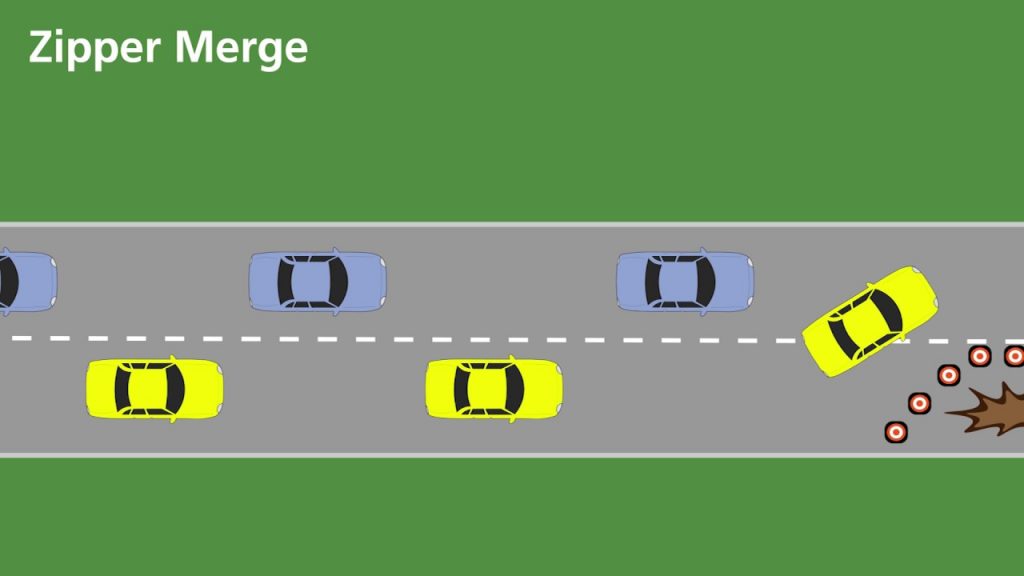
Remember that every-single-time you’ve been on the highway, cruising along, minding your own business? When, all of a sudden, out of the blue, somebody has parked a trailer with a blinking sign and a portable generator to run all night. It barks out it’s warning of danger “LANES MERGE AHEAD,” or “1 LANE AHEAD.”
Of course, because you are a nice person and responsible driver, you dutifully move into the selected “open,” lane, and immediately start cursing everyone that is flying by you in the lane that you just evacuated. They are not nice people. This is theft, we don’t do that, in America!
So, you retaliate, as I have often done. You straddle the lane lines, hoping to ward off the next incursion into your space. You’ve been waiting in line, damn it! That asshole is stealing your time!
If only those inept construction crews had bothered to warn you sooner… That sign was way too close to the merge point, and the merge too severe.
Well, dear reader, it turns out that you are wrong. Yes, that is a purposefully designed funnel. No, you should not have gotten over so early. Not only have you caused yourself heartburn, anger, and possibly dangerous road rage; you have also contributed to the undoubtedly miles-long backup, behind you.
As with all great ideas, the problem is in the implementation. And, by that, I mean that you probably don’t know that you’re supposed to be one of the assholes staying in the to-be-closed lane up the very last second. Or, if you chose to stay in the open lane, you probably don’t know that you’re supposed to let one guy in front of you from the other lane. I see the problem as one of education. A lot of us learned to drive from our parents: years of observation followed by a few scant hours of official instruction and road work.
Not to worry, though. Pretty soon, it will start to be a moving violation, punishable by fines or more. Oh, wait.
It already is, in some areas.
So, think of this as a money- and aggravation- and time-saving tip. Be the asshole.
As the vaccine for Covid-19 rolls out to the United States and the rest of the world, Immunologist Dr. Jason Goldsmith joins us to discuss the implications, considerations, and specifics of how it was created so quickly, putting to rest conspiracy theories and nonsense about the state of the pandemic.
(Editor’s note: Multiple staff contributed their expertise and analysis to this article.)
Well, that was a fun November.
Now that we’re deep in the throes of President Donald J. Trump’s certified re-election loss, real conspiracies are coming to light. And, we love to hate conspiracies, it is the lifeblood of Bullshido. So, it’s time we take a hard look at Dominion, or more specifically, a suit filed in Antrim County, Michigan, and the subsequent findings.
But, before we strap in for this long ride, it’s necessary to point out that our mission, as willing continued participants in this thing we call civilization, is to root out corruption and identify preventable mistakes. Maybe some shady stuff happened, in this election; certainly much has been alleged, and we’ll get to those, in turn. This is not a defense of Dominion, it is an examination of bogus and/or faulty claims, and why they undermine real efforts at countering corruption.
While reviewing most security analysis and reporting there is usually a proven event to work back from, such as a data breach, malware alert, or other known incident. Then, the researcher attempts to recreate how this occurred and maybe if apparent point to a motive. However, in the case of the Allied Security Operations Group (ASOG) reporting on Dominion’s voting systems, it seems the original premise of the investigation was flawed. The report assumed immediately that there was wide scale fraud in the 2020 election, a premise that has been without hard proof. As a result, there was no “smoking gun” event to work back from. Therefore, what follows is a series of basic security reviews, assumptions and conjecture that does not much as prove the original hypothesis, that fraud has occurred, but a situation where an analyst could say “Yes, I can see it is possible.”
Cue our chief actor, Russell James Ramsland, Jr., a “cyber security expert,” who boasts an MBA from Harvard, and a political science degree from Duke. Not a whiff of education on computer forensics, electronics, or any sort of technology on his resume, but that’s OK – we can still smell him from here. To be fair, it is not requisite to have experience with boots on the ground when you’re just a middling executive that is being held out as the head of this investigation. However, we think that experience in those issues would have prevented some of the claims he has proffered. We will use the term “they,” often, as Ramsland has indicated that it was a team effort at ASOG. But, our conclusion is that Ramsland should be embarrassed to have entered this tripe into the public record (spoiler alert).
First, Ramsland has come to some small amount of infamy, during the course of this process, for misidentifying cities in one state, for those in another, and providing statistical analysis of voting counts which defy belief. In one case, an over 780% increase in voter turn-out led his list of alleged misdeeds. That is perfect red meat for an audience that wants to believe in their disenfranchisement, in spite of the bald face of facts.
But, the piece de resistance is this forensics report, which we find several issues with. You may read the full report, here, at your convenience:
Before getting too deep, it’s important to understand how this process works. First, a voter fills out a ballot, by coloring in the circle (or rectangle) next to their choice. You know, the kind of thing you learn in grade school. Then the ballot is cast by feeding it into a scanning machine. The scanner tallies the individual choices into buckets, both digitally and literally. If you have used a spreadsheet program, you can think of these digital buckets as cells on the spreadsheet. Periodically, the digital buckets are carried on a memory card to a central tally machine. That final step plays heavily in this report. The paper ballots are retained, in case a recanvassing and recount needs to occur.
The Report
We’ll skip the opening “we’re great at what we do, because reasons,” and head right for B.2:
“We conclude that the Dominion Voting System is intentionally and purposefully designed with inherent errors to create systemic fraud and influence election results.”
That is a pretty extraordinary claim and one that we want to sink our teeth into. If true, the safety of mankind is at risk.
In computer parlance, an error is the failure of a piece of software or a system to accomplish its designated purpose. Generally speaking, errors in computing are the result of bad input data, or flawed programming logic. ASOG gets this pretty much correct, and then makes some bad leaps. Computer software always does what its programmers have told it to. The allegation is that there is some “magic,” in play to cause ballot rejections, which require human intervention. This is key, ground zero. A rejected ballot should be rejected again, if the software is operating correctly, or without human intervention. In fact, it was the upstream tabulation machines which were at fault for the majority of the issues claimed in this report.
“The system intentionally generates an enormously high number of ballot errors.”
The system is a motorized optical scanner. This means it needs periodic maintenance, such as cleaning and lubrication. It also means that a ballot could be rejected if it is inserted incorrectly. As the source code was redacted, we don’t have a remedy to determine the validity of this claim. Suffice to say that the judge hearing the case would have to be in on the conspiracy, if there was sufficient evidence presented to support this claim, as he released this report but ensured that the internals were redacted.
“The electronic ballots are then transferred for adjudication. The intentional errors lead to bulk adjudication of ballots with no oversight, no transparency, and no audit trail.”
The Adjudication Problem. On Page 3, we are revealed to the stunning figure that the Dominion System rejected 81.96% of votes as needing review. These ballots were sent to an Adjudicator for review. That is, by definition, oversight – how else would they get counted? There is an assumption that the votes at this point could be changed by human intervention, however there is no proof that they were. In fact, in the report there doesn’t seem to be any code review or reverse engineering of the Dominion code base to determine why nearly 82% of votes required review. Software updates are commonly mentioned throughout the report, but nothing about what error or bugs were fixed in these updates is related.
“We disagree and conclude that the vote flip occurred because of machine error built into the voting software designed to create error.”
That sentence should be taken out and shot for crimes against the English language. His trampling of the meaning of error is abhorrent.
“We observed an error rate of 68.05%. This demonstrated a significant and fatal error in security and election integrity.”
No, it demonstrates that the scanning machines were not able to recognize the chicken-scratch Michigan voters learn in their pathetic public schools. (Editor note: Hey! I gradumated from Michigan public schools!)
“68.05% of the events were recorded errors. These errors resulted in overall tabulation errors or ballots being sent to adjudication… All reversed ballots are sent to adjudication for a decision by election personnel.”
Exactly. They were sent to humans for manual review. Perhaps we should revisit the human error angle? Are you not reading your own report?
“Ballots sent to adjudication can be altered by administrators, and adjudication files can be moved between different Results Tally and Reporting (RTR) terminals with no audit trail of which administrator actually adjudicates (i.e. votes) the ballot batch.”
So, the software worked, and humans are to blame. About 3 paragraphs apart, you should be able to find these:
“The Dominion Voting System produced systemic errors and high error rates both prior to the update and after the update; meaning the update (or lack of update) is not the cause of errors… This was a 2020 issue not seen in previous election cycles still stored on the server. This is caused by intentional errors in the system.”
First of all, an update to the software should have gone through the same rigorous testing that led to the initial error which necessitated an update. It should not have been certified by Michigan authorities to be put in place without such testing. Again, this is not a software error.
Despite their own report making the case for human error, they continue on to allege the following:
“The statement attributing these issues to human error is not consistent with the forensic evaluation, which points more correctly to systemic machine and/or software errors. The systemic errors are intentionally designed to create errors in order to push a high volume of ballots to bulk adjudication.”
They are saying human error is not responsible, and then saying human error is responsible. And, there is scant if any evidence that any ballot was not properly adjudicated.
Meanwhile, the State has published a more easily digestible explanation – the update in question was related to a specific configuration and was most certainly human error. Relying on the spreadsheet analogy, from earlier, the digital buckets were mislabeled internally. This is a configuration error caused by a human, and it was identified and fixed. But, again, not a software error, intentional or otherwise.
The Security Posture Problem. As expected with offline servers in small districts the Security posture of the server was poor. Unencrypted and not regularly updated is pretty par for the course, however, again the report only concludes that with enough access and knowledge of the system, the server could be accessed covertly. However, there was no evidence of modification or hostile software installation. Similar to coming up to a home, with an easily pickable lock. Just because a thief could break in doesn’t mean you have been robbed. Especially if you aren’t missing anything. The one point that is of interest is the missing security logs prior to 11:03pm on November 4, 2020. Unfortunately, they are never mentioned again. What were this logs? Were they on the voting machines, the Windows Server they forensically imaged? Are they from the Operating System or Voting Software? Was any attempt made to recover them? Was was the Log Rotation Schedule? How often are the logs cleared by the OS or the software. Without further information this could be evidence of covering up misdeeds or basic server maintenance. For some reason, the report neglects to go down this path.
The ASOG report goes on to describe their methodology and detailed findings, many of which are redacted. Suffice to say that Ramsland draws a picture of a system that has been woefully mismanaged, perhaps criminally so. He makes sure to get in jabs at Canada and China, which is not strictly necessary for a forensics report. But, drawing a line from poorly managed systems to a hack or an intentional software glitch is an incorrect conclusion, based on the information presented. Perhaps someday we’ll get to see the redactions restored and can draw a different conclusion, but you can rest assured that the enormous amount of scrutiny given to Dominion across 28 states and Puerto Rico means that the machines themselves work correctly, when maintained and operated correctly.
Overall, the report spends most of its time assuming the election fraud as happened and goes about trying to prove it. With a lack of evidence of tampering, it makes every minor error, software update and less than perfect security posture evidence of a massive fraud narrative. This reads less like a network attack and more like a conspiracy theory.
As a footnote, Dominion has now filed a Cease and Desist order against Sydney Powell, she that was dismissed from Trump’s legal team. You can read about that, here.
Harald Hänisch was a city councilman from Böhlen, Germany who played a leading role in the November 7 Anti-Lockdown protests held in that country. 8 days later, he was in the hospital, intubated and fighting for his life.
He lost.
The group he was representing deleted associated posts on Facebook.
Schadenfreude
In recent weeks, a growing amount of discontent has taken root in Germany towards public health restrictions the country has implemented in response to the global Coronavirus (SARS-COV-2) pandemic. Some have attributed this, in part, to the early success the country had in getting the disease under control and, consequently, have begun to doubt the seriousness of the virus and the merit of any restrictions necessary for keeping it under control.
Germany’s successful early response to the Coronavirus pandemic may have unintentionally caused some Germans to doubt the seriousness of the disease.
Compared with the response in the United States, Germany crushed the first wave of the virus and kept it under control for a long time, but now it seems both fatigue for restrictions and a coalition of bad actors spreading conspiracy theories seem to be contributing to a dramatic increase in cases.
Links to Right-Wing Groups
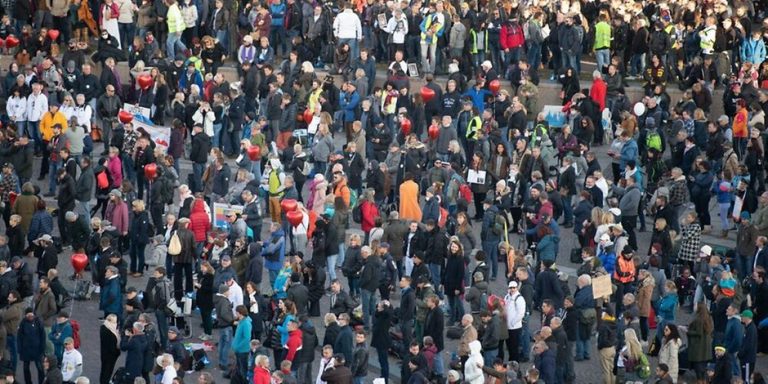
German protester carrying sign in English with a collection of conspiracy theories
German officials are now probing possible links the group, “Querdenker” (lateral thinkers), has to their own far-right version of QAnon. The regional governor of the German province Bavaria, Markus Söder, is warning of a “growing conglomeration of right-wing extremists, Reichsbürger, anti-Semites and absurd conspiracy-theorists who accuse politics of satanism” and is demanding German domestic security and intelligence services investigate the matter.
Das Grundgesetz garantiert ein Demonstrationsrecht. Es beinhaltet aber nicht das Außerkraftsetzen des Gesundheitsschutzes. Es ist wichtig, dass Corona-Maßnahmen überall eingehalten werden. Auch bei Demonstrationen! Für Querdenker gelten keine Sonderrechte.
“I want to expose what I call ‘Corona-mania'” LaTulippe said at the “Stop the Steal” rally of November 7th. He went on to say that the Coronavirus was “rapidly-mutating”.
This is, in fact, exact opposite of what SARS-CoV2 researchers have concluded. Indeed, compared to other single-strand RNA viruses, the relatively slow mutation rate of the virus responsible for Covid-19 has been a boon to vaccine researchers, reducing the amount of effort needed to address variants.
LaTulippe listed as his credentials his service in the Air Force and his status as a Christian minister, before transitioning directly into a confession that he and his staff refused to wear masks in his clinic, which was met with applause by the audience.
The now-former Oregon physician “petitioned” the crowd to “take off the mask of shame” before making wild claims that the public health measures were designed to undermine the Constitution and more ridiculously, conflating the “diameters” of the virus with the particle filtration of the N95 mask, which disingenuously omits the fact that masks are for preventing the spread of respiratory droplets in which the virus is contained.
This is a common argument among denialists and downplayers, taking advantage of the general public’s lack of understanding on how public health mitigation practices are implemented, and poor scientific literacy in general. Many often key in on a single solution’s inability to completely prevent infection, while either being ignorant of or deliberately omitting the fact that each is a part of a broader comprehensive strategy to reduce, not completely eliminate risk.
The State of Oregon Takes Action
In response to being made aware of the video, an investigation was conducted. On December 3, the Oregon Medical Board issued an emergency suspension, finding that LaTulippe “engaged in unprofessional conduct or dishonorable conduct” for informing patients not to wear masks and not to self-isolate based on the idea that others should be infected to obtain herd immunity. Furthermore, the investigation determined that indeed his office did not require masks, did not screen patients for symptoms, and did not even offer hand sanitizer.
The board concluded that LaTulippe “”constitutes an immediate danger to the public, and presents a serious danger to the public health and safety.” He is now barred from practicing medicine anywhere in the state of Oregon.
On a continuum of what is true, narratives tend to lie on the end opposite facts. The grander the narrative, the stronger this effect seems to be, as the purpose of a narrative is to inculcate people with a simplified, nuance-free view of something—often for the purposes of nudging or even outright controlling the behavior of those who subscribe to it. That’s a whole mess of words to explain the fact that the more grandiose a story is, the larger the pile of bullshit it is built upon.
Consequently, pesky stuff like “objective reality” and its accompanying facts tend to poke enough holes in narratives as to sink them faster than the Lusitania, which upsets the people who are trying to exploit such zealotry for their own ends; like starting wars, or economically colonizing third-world countries.
Narratives and nuance are natural enemies.
Blub blub blub, we’re off to war!
Nationalism, as a political movement, runs the gamut of only-slightly-concerning—like that uncle of yours who spends ALL of his vacations in Thailand—to, on the other end… you know… that whole “Hitler” thing. But one of the key attributes of nationalist thought is that it requires belief in narratives—both grand and trivial—but always centered on the superiority of said nation over others. Most people in our audience—especially in the past few years—are likely to associate the term with the preceding modifier “white”. But the good news is that nationalism, ethno- or otherwise, is certainly not limited those of our American neighbors who see 23andMe as a dating service.
You know who else has a problem with nationalism? China.
Chinese Nationalism
To be clear, we’re not going to delve into either American or Chinese nationalism in any depth beyond the consequences of the latter, because by now we’re pretty familiar with the consequences of the former. But we couldn’t get to the substance of this piece without making it clear that shameless flag-humping is far from an exclusively-American phenomenon limited to people whose 4X4 tire height is 8σ above their IQ.
Exhibit 子:
While you probably recognize the poster to American Sniper, you may not be aware of “Wolf Warrior“. It’s not a perfect parallel beyond the posters since Wolf Warrior is completely fictional whereas the story of Chris Kyle is true…ish, sorta. This is beside the point though, because the common thread is sewn into the flappy bit of cloth in the foreground.
If you’re bored, feel free to watch the film and note the similarities between it and American movies of the same genre. We all had better things to do here, so I asked Matt Foster, a film critic with The Nighthawks Podcast, for his take on it:
“Fuck off Phrost, I’m not watching that crap just to pad your article.”
-Matt Foster, Nighthawks Podcast
Anyway, you can find the movie for yourself somewhere and watch it with subtitles; or if you’re Australian, go ahead and learn Putonghua since you’ll need it eventually anyway. In the present and immediate future, however, it is important to maintain an active awareness of two things:
The fact that all the major global powers rely on nationalism to varying extents.
Sheltering the narratives on which it is built from fact-checking and critical scrutiny is essential to that purpose.
QiAnon?
Too bad this is bullshit, it would be pretty neat if we had the equivalent of IP addresses for neurons.
The idea we’ve been dragging you by the earlobe towards this entire time if you haven’t already put it together by now (which you have, because if you were stupid you would have stopped reading at that abomination of a second sentence), is that people like our core audience who prefer to seek out an evidence-based understanding of the world are a threat to any political ideology which relies on idealized narratives. And in countries like China where these narratives are interwoven into thousands of years of history with threads of mysticism and superhuman prowess virtually inseparable from cultural pride, questioning these things can be an act of subversion against the state.
So-called “Traditional Chinese Medicine” is perhaps the best example of this. Any culture spanning thousands of years like China (and let’s face it, there aren’t many of them like China), is out of necessity going to have a rich history of folk remedies that predate modern science and more rigorous empirical verification of efficacy. And to be fair, some of them might actually work for their intended purpose, if only inconsistently and in wildly-varying degrees given the imprecise manner in which therapeutic dosages are administered—it’s not like some guy with a cabinet filled with ground yak penis is monitoring peak and trough serum levels or measuring a steady state concentration of the dose.
Shelf upon shelf filled with rare and exotic placebos
Aside from the catastrophic effects on wildlife resulting in nonsensical beliefs that ground rhino horn works like Viagra for flaccid Chinese dudes, of course the broader concern is when people turn to “alternative” instead of legitimate forms of medicine, resulting in deaths that could have been avoided—such as what happened to Apple co-founder Steve Jobs.
China’s Mad Dog, 2020
The case of Xu Xiaodong is yet another example of this. The “Mad Dog” MMA fighter achieved international notoriety by challenging highly respected Chinese traditional martial artists to provide evidence for their grandiose claims of fighting prowess, and then promptly beating all of their asses. Here’s one of the events, for your enjoyment:
While there are official legal reasons (excuses/justifications) for these consequences, what is evident to everyone who isn’t an uncritical apologist of this system is that real reason Xiaodong has been sanctioned is not for the black eyes he has given the practitioners of ridiculously ineffective fighting styles, but the black eye he has given to the narrative of traditional Chinese martial arts superiority, by using an ostensibly “Western” fighting style.
Martial arts are central to Chinese identity in many respects. Reasonable arguments can be made that the Bruce Lee himself, along with the explosion of popularity of Kung Fu movies in the 70’s, helped raise the profile of Chinese culture in the Western world. The films certainly increased the mystique if not status of Chinese immigrants who had, for the most part, previous lived in insular communities in major cities in the United States. And as we’ve already observed, while anything which reduces xenophobia and out-group fear can be considered a net positive, such things are not without their value for the exact opposite purpose. The intersecting agendas can create strange bedfellows as legitimate concerns about anti-immigrant racism sometimes often serve the same interests as those who promote nationalism in their own countries.
The involuntary casting call for the live-action Mulan film, or just regular genocide?
Indeed, highlighting the racism in Western countries as an integral part of capitalist economic systems as opposed to communist, was a popular tactic used by the Soviet Union throughout most of the cold war. China itself, even recently, has cynically decried racism in the United States while conducting a campaign that can not-unfairly be described as genocide against the Uighur people within its borders.
Self-aware purveyors of bullshit—unlike those who are either legitimately incapable of discerning reality or those for which the incentives for denying it are greater than the consequences—are perpetually on guard against potential sources of scrutiny against the narratives they spin. And when this takes place at the level of geopolitics for the highest stakes imaginable, such scrutiny of narratives serving the national interest is, of course, considered a threat to the state itself; especially when “the state” is misrepresented as those who are entrenched into positions of power within it and the line is deliberately blurred between the two. Bullshit is rarely stacked only one layer high, and when a nuclear power—any nuclear power—employs it as a central portion of both their domestic and foreign policy, things can get ugly.
…well okay then!
The Punch Line (brought to you by Kool-Aid)
Like any group of people who are willing to uncritically accept absurdities, the believers in both “traditional Chinese medicine” and the superiority of fighting styles that avoid full-contact sparring are, ultimately, rubes that serve the interests of bad-faith actors who exploit their lack of sophistication, critical thinking, and willingness to exchange belief in a narrative for membership in a group. When this takes place at the national level this is called Nationalism.
And we all know what happens when people are willing to believe absurdities.
(If you skipped to the end, “Voltaire” isn’t a type of candle, FYI.)