The physically strongest people you know rarely are that strong because they just wake up that way. No, they invest significant portions of their time putting in the work necessary both to obtain, and maintain it.
The same goes for the mentally strongest people you know.
Granted, it’s much easier to pick out someone who is physically, rather than mentally strong, but there is a lot of overlap between the two if you know where to look. Indeed, while larger muscles and regular feats are hard not to notice, being less-susceptible to the influence and manipulation of the endless numbers of bad actors out there who jerk people’s emotional chains or abuse their ignorance on various topics, often only manifests in very subtle ways. And many of the ways they do manifest make the average person feel uncomfortable, such as the guy you know who flatly and firmly says the word “no” as a complete sentence in itself, without adding layers of grammatical bubble wrap around it.
Anyone with the willpower and focus to develop mental strength can go from being the proverbial 97 lb. weakling to a Charles Atlas of cognition. Unfortunately, as yet there are no gyms for the mind, and even worse, there is no end to the number of self-styled gurus out there who want to sell you a load of goods from the back pages of the world’s current version of pulp magazines: social media.
Lol, Charles Atlas skipped leg day.
With that in mind—and the fact that countering those people is a significant part of our mission here at Bullshido, here is a short list of concepts that will help you avoid getting sand kicked into your brain:
Bonhoeffer’s Theory of Stupidity
“Stupidity is a more dangerous enemy of the good than malice. One may protest against evil; it can be exposed and, if need be, prevented by use of force. Evil always carries within itself the germ of its own subversion in that it leaves behind in human beings at least a sense of unease. Against stupidity we are defenseless.
Evil can be guarded against, but stupidity cannot, and it is endemic in the human race.
Dietrich Bonhoeffer
This conclusion may seem cynical, even defeatist, but if you know the story of Dietrich Bonhoeffer, you realize comes from a place of empathy and sadness for the state of his country and humanity as a whole. Bonhoeffer was a Lutheran minister in Germany around the rise of the Nazi party. He publicly lamented the descent of that country into fascism, with ordinary people violently turning on their neighbors along lines of race and other immutable characteristics. For his efforts, he was put in prison where he did much of his writing on the subject, and eventually executed.
Evil rarely comes in the form of a mustache-twirling villain or someone with skull emblems on their uniform. And in nearly every case where it does, it is empowered and defended by the stupid—people whose emotions rule them and refuse to accept much less acknowledge contradictory evidence. Indeed, “stupid” people, in this sense, become irritated and even violent when they are contradicted on their beliefs—thus creating a defensive barrier around even the most ridiculous and heinous beliefs that most normal people do not have the determination and strength to try to penetrate. At scale, this results in atrocities.
Knowing is—at best—a third of the battle
This one’s for the Gen-Xers—move along.
Being aware of Bonhoeffer’s Theory gives you an advantage in several ways, including the ability to reflect on whether or not you fall under this encapsulation of stupidity, helping to address that. But more importantly, you begin to see its effects at scale: in social situations, mobs, and especially as the underlying cause of many of our problems as a society. And being aware of how the stupid are exploited by sociopaths, along with the full scope of consequences for it scattered though the bloodstained history of mankind, you begin to see how you should put at least a little effort to reduce stupidity in your sphere of influence—even if it’s just grumbling a bit less at writing out that property tax check that goes to public education.
Gibson’s Law
“For every PhD, there is an equal and opposite PhD.”
On first glance this concept would appeal to the type of quarter-wit that loves to trot out their basement bedroom philosophy degree from the University of Cannabis with some variant of, “we can’t really know anything”, or “science is just a bunch of assholes making shit up”, or “magnets, how do they work?”
Instead though, this concept is helpful to grasp the utter nightmare of dealing with people who promote the Magnified Minority—the ridiculous voices on the fringe who give in to the irresistible and overwhelming incentives for catering to people who want to believe the opposite of whatever the current consensus is on a subject.
The reality is that while there isn’t remotely parity between the number of PhDs in a field who agree with the consensus and the fringe contrarians trying to claw their way to notoriety or Patreon subscriptions by spreading bullshit, it sadly only takes a handful of them to muddy the waters, especially given our previous entry into this list.
Furthermore, this effect is exacerbated by one particular skill set that is developed in the process of earning a PhD: the ability to rationalize and defend any conclusion irrespective of how wrong it is. As Gurwinder Bhogal said, “…having a PhD doesn’t make someone right, it often just makes them more skilled at being wrong.”.
The takeaway?
There are a ton of heuristics that do a reasonably good job of sorting out the credibility of a person’s contribution to a subject, and while having earned a PhD is one of them, that doesn’t make it foolproof—there are always highly-talented fools around.
The Shirky Principle
Prisoners working for a for-profit company to serve their time.
“Institutions will try to preserve the problem to which they are the solution.”
Speaking of incentives, another thing to be aware of and on the lookout for when making everyday decisions, is the reality that so many of the organized solutions to complex and difficult issues that people have come together to devise, eventually end up perpetuating those issues in order to ensure said organization continues to exist. The reasons for this aren’t too complex, ranging from people who pay their bills by working on the issue (and would have to find employment in a completely different field), to personal or emotional investment in the institution and not wanting to see the glorious struggle end—like some aging rebel still trying to stick it to the man (from his 6 bedroom McMansion in a gated community).
It’s at this point where we at Bullshido have to do a bit of gratuitous horn-tooting, by way of providing an example for other organizations.
As many of our readers are aware, we started this project over twenty years ago, mainly to call out BS in the martial arts and combat sports, with a few side trips into stolen valor and other forms of prestige or credibility theft.
Towards the end of our first decade, however, it became apparent that there were fewer and fewer examples of frauds, or cranks, or shameless con-artists left in the world of martial arts that the people who were interested did not know about. Indeed, as we were one of the groups that most strongly promoted the sport of Mixed Martial Arts—not only as a pastime, but a means to test whether someone actually could put their martial arts skills into practical use—the sport’s rise in popularity did more heavy lifting on getting the average person to understand what actual fight skills looked like in action, rather than in action movies.
Once that became clear, and the only people who were left believing ridiculous ideas like how you don’t really have to spar to be good at fighting (like James Lindsay here), were too sad and pathetic to spend much time trying to dunking on much less convincing. And consequently, we started going after bigger, more dangerous forms of bullshit that pervade the health, wellness, and fitness industries.
Takeaway?
Knowing why some serious problems persist despite having well-funded institutions dedicated to addressing them, is the first step in addressing that meta-problem. And speaking of well-funded institutions—which we are not—here’s a link to our Patreon page.
Us, after getting a $3 a month contribution so we don’t have to cut back on lunch to keep this project running.
Ever dream about just saying “F it” and going to train an obscure martial art in a foreign country? Alyxe Khei did, and then lived that dream. He joins us on this episode of The Art of Fighting BS podcast to discuss tips and advice for people who want to visit exotic places and get punched by the people who live there, and we delve into the real history of Martial Arts and how ethno-nationalism looms over virtually every one of them.
Should you get the new bivalent booster? After all the back and forth between public health officials and social media influencer/grifter cranks, you’d think this would be a simple answer. Unfortunately, data isn’t simple, people are.
Dr. Jason Goldsmith returns to the podcast to provide the latest, BS-free information on the subject. As always, vaccinate yourselves and your loved ones, but the human predisposition to turn everything into an us-vs-them tribalist hellscape of competing narratives almost always lays waste to the facts on every side of an issue.
In this episode
Update on the pandemic
Who should get the vaccine (everyone)? But who should get the latest booster?
Is “doxing” ever okay? It is when we do it! Of course, that’s exactly what literally everyone thinks—from the cheese puff-encrusted incel to the head of investigations for a grass roots consumer protection organization (ours).
In this episode of The Art of Fighting BS podcast, legendary Bullshido investigator and attorney Samuel “Sam Browning” Browning joins us to discuss both the legality and ethics of doxing with current and past examples, including Bullshido’s own use of the practice over the years.
Show Notes
Topics discussed include:
The now-defunct Kiwi Farms forum vs transgender activist and streamer Keffals
Various investigations and examples of our own use of “doxing”
Hypothetical: Joe Rogan’s medical/vaccination records?
And more…
Watch the video below, or listen on your favorite podcasting platform:
The latest in a seemingly endless string of things for the public to be frightened of comes in the form of a drug that, while legitimately dangerous, has been portrayed as lethal to such an extent that skin contact with a miniscule amount sends people—in particular, law enforcement personnel—into immediate convulsions and ultimately the hospital.
Paramedic and podcaster Mark Edwards comes on the show to help sift facts from BS about not only this drug, but the darker side of law enforcement in the United States in general.
Here’s a clip from the recording:
Listen below, or on your favorite podcasting platform (search for “Bullshido” or “The Art of Fighting BS”.
The world of martial arts has a persistent, significant problem with sexual predators, particularly those who work their way into positions of authority as instructors and coaches. William Murphy, PhD, a third-degree Brazilian Jiujitsu black belt and instructor, comes on the show to discuss how this problem can be addressed, and the professional ethics involved in being an instructor.
Listen below, or on any major podcasting service (iTunes, Spotify, etc.)
Psychedelics and DMT in particular are a popular topic on podcasts involving what we like to call the “Bro-verse” and less skeptical midwits and galaxy brains in general. To address this, we bring on an expert in the industry to explain what they are and are not, the difference between having a truly profound experience and BSing yourself, and to discuss some of the latest updates on actual scientific research being conducted on them instead of just a couple burnout stoners talking about seeing interdimensional space elves and other ridiculous crap.
Listen below or subscribe on your favorite podcasting platform (Spotify, iTunes, etc.)
This is an opinion piece. Normally, I like to stuff my work with factual references and strong objective data to back up my assertions. In this case, I lean heavily on my personal experiences to inform my thesis. I encourage you to take everything I say here with as many grains of salt you might like. I will attempt to be as fair as possible to all mentioned parties.
And We’re Off!
I’m going to start this off with some videos. Take a look at these and ask yourself what they all have in common. I’ll wait.
The answer is not: “Cops are bad.” Despite all the image issues law enforcement has at the moment, the vast majority of police officers out there are not bad in any objective sense… unless you mean, “bad at physically subduing suspects.”
These videos all depict law enforcement personnel attempting to manage or restrain people and failing egregiously in the process. There are many thousands of such videos floating around.
I’ll pause here to point out that this is not a universal phenomenon. Law enforcement personnel exist on the same spectrum of physical competence as the rest of the population. When it comes to the ability to safely restrain a resisting human, your mileage may certainly vary. Some will have no skill at all, others will be pro-level fighters. All the rest will be somewhere in between.
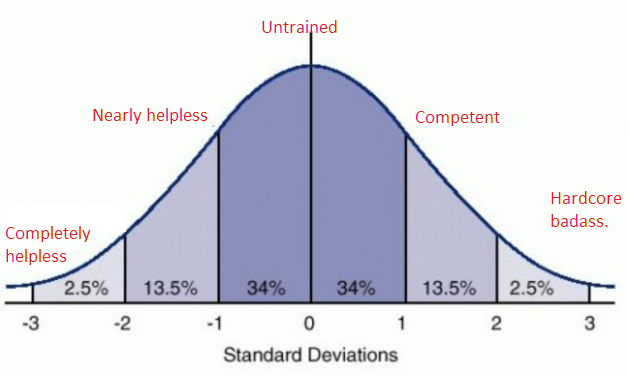
And therein, dear readers, lies the problem. Our LEOs have been tasked with inserting themselves into those situations where physically managing and even subduing resisting people may be necessary. Physical conflict is literally in the job description. Where on the curve do you think the typical LEO should be?
That’s a loaded question, obviously. If your job enjoys the inevitability of physical altercations, you should want to be as far to the right as your natural abilities can get you. Yet over and over again, we see the realities of an LEO community that has simply decided this is not the case. Why is this? How do our law enforcement agencies permit this obvious¹ deficiency to persist? Well, like so many of the questions that seem simple on the surface, this one is much more complicated than it appears.
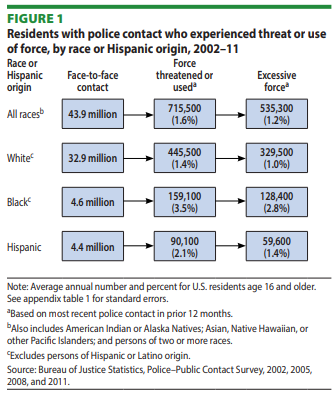
From the Bureau of Justice Statistics: 1.6% of all police interactions involve the threat of or use of physical force. Statistically, it is nearly impossible for an American police officer to go their whole career without facing the threat or reality of physically fighting with a citizen.
What is PMT?
“Physical Management Techniques” is a term that refers to the techniques and strategies one might employ to safely subdue and restrain another human being. Police are often trained to arrange the types of intervention into a spectrum called the “force ladder.” Each “rung” in the ladder is a higher level of intensity and/or violence. The goal is to stay as low on the ladder as possible while maintaining control of the situation. In most forms it looks like this:
Level 1 – Officer Presence.
Level 2 – Verbalization (Verbal Commands)
Level 3 – Empty Hand Control.
Level 4 – Less-Lethal Methods.
Level 5 – Lethal Force.
Level 3 is where “PMT” lives, and it is the last step on the ladder before things start to get a little scary.
My personal introduction to PMT came from my overlords at a state department of mental health where I was once an employee. I was subjected to classes outlining the specific techniques we were permitted to employ when dealing with a violent individual under the auspices of said mental health department. You will note that these were “permitted” techniques. Which is to say, that techniques not taught as part of this training were “not permitted.” Using techniques that were not permitted pretty much guaranteed disciplinary action and firing.
The training took two 8-hour days, and the best thing I can say about it is: nothing. It was the worst garbage I had ever seen. How any lucid human could ever believe that the permitted techniques would ever be safe or effective I cannot say. I simply shook my head and thanked all the gods I could name that I was a 230-lb 21-year-old judo brown-belt ex-boxer with previous work experience in security.
Look at this dork-ass dork, dorking his way into emergency dental surgery, with his toddler-sized punching bag in the background -ed.
How bad was it, really? The training advocated things like blocking a low kick by reaching down and grabbing it. We were meant to manage punches with that mid-80’s karate movie staple, the X-block. The only permissible hold was a sort of bear-hug from behind called a “basket hold.” Here it is in all its glory. To take a person down, we were expected to execute the basket hold and then sit down. That is not a lie. That is what they told me to do.
None of the techniques were drilled more than a few times. All of the training was done at very low speed, with fully compliant and cooperating partners. Much of the class time was spent explaining all the ways you could get in trouble for not sticking to the seven or eight approved techniques. Police PMT training varies with academies and departments, but tends to be a little better than what I received. Even so, the average US police officer trains in PMT less than four hours a year with very little practical application either on the mat or off.
How Competence Affected Performance in the Field
Our clientele did not have much control over how they behaved, and in many cases, violence was the only language they had for expressing their frustration or anxiety. Some of these people could be extremely violent from time to time, often with little or no warning.
Managing that kind of violence was in the job description from day one, and I was expected to always comport myself as a calm professional. I was young and idealistic, so I resolved myself to do the best I could despite the woeful inadequacy of my training. I’m not sure if I succeeded, but I learned a lot about myself and the nature of fear doing that job. I also got punched a lot.
It is very important to know this before I continue: The industry (at the time) was populated almost entirely by middle-aged women². My employer, who understood what my previous training and physicality represented, made it very clear what my role was³. My assignments universally included the most violent and unpredictable clients of this organization, and this was an organization that specialized in “behaviorally challenged” individuals.
And holy shit, was that a good thing.
I observed a great many things while doing that job. Things that are hard to think about and still hard to write about. Relevant to this piece, I saw how a 50-year-old woman with sciatica reacted when a behavioral incident kicked off. I saw how dealing with that fear every day dictated how she managed those risks. In short, the woman in this example should have been fired for the things she did out of fear⁴.
I struggled very hard with this. I did not feel her fear, so her behavior disgusted me. Then again, I fell on the right-hand side of that bell curve. My level of anxiety when dealing with aggressive individuals was a fraction of what that 50-year-old woman with sciatica experienced. My reactions to violent outbursts were far more judicious and calculated because the threat level to me was minimal. What was very real physical danger for her, amounted to little more than a nuisance to me. In the end, I had to acknowledge that while her behavior was wrong, the fear driving it was very real.
The point of this anecdote is not that I am a big strong man. The point is that competence in the physical management of violent individuals reduced my fear of them, and thus engendered a more judicious response. I could afford to hold back my full strength because I had plenty of it. I could afford to limit my techniques to the utter garbage my employer required because years of judo meant I could make them work. I did not have to swallow my fear of getting hit or hurt because my lifestyle and training had made me comfortable(ish) with both.
I was not a cop, of course. Thanks to my training and physicality, the threats I faced rarely extended to the realm of real physical risk. So, to lend my stories and conclusions some credibility, here is a short (but not complete) list of things that happened to me over the four years I worked in the mental health industry.
Attacked with an iron garden rake my first week on the job. Got bit hard in the crotch during the restraint process. Sat there holding on for dear life while a grown man tried to gnaw through my jeans and four other people ran around like chickens with their heads cut off waiting for the ambulance to come and sedate the guy.
Punched in the face. Like every week. Apparently, I have a punchable face. (Agreed -ed.)
Boiling water thrown on me. Went full Neo to dodge most of it. Most.
Attacked with steak knife. Guy’s heart wasn’t really in it though. He put it down when I told him I did not need this job bad enough to stick the rules of engagement on this one⁵.
Victim of weaponized vomit a bunch of times. Getting spit on was common, as well.
Stuck with insulin needle in my hand. Pretty sure it was unused.
Bitten and/or scratched to the point of bleeding numerous times.
Hit with vacuum cleaner handle. I actually laughed at that one. The attacker was a 70-year old woman who weighed about 90 lbs. Felt like bumping my head on a door frame at really low speed.
I am proud of the fact that in none of these situations did I scream, yell, or beat the crap out of the clients. I wanted to, but I knew that I had a responsibility of care. I had to be judicious and professional because that is what I was paid to do.
Which Brings us To Cops
Swear to god the pre-written stock caption on this photo we licensed was “Heroic responsible policeman with gun in hand coming out to fight, law and order”. JFC -ed
On a far grander scale, our law enforcement professionals also have a duty of care. Physical altercations are also part of the job description for cops. Rounding out the similarities, the training most police receive in the complex skill of physical management is simply inadequate for the task. I work out and train with about a dozen law enforcement officers from various departments and one thing is universal: virtually every department fails in teaching the most effective ways to subdue and restrain a resisting person. To their credit, I have never encountered a law enforcement official who felt that their department did not try to do a good job. The deficiencies are not born out of apathy, but rather the challenges faced.
Let me tell you what came to my mind when I watched it. By the end of the video, you will have seen two Aurora, Colorado police officers beat and choke a single unarmed man for more than six minutes before managing to get him cuffed. The man was uncooperative, necessitating PMT, but otherwise completely non-aggressive. In truth, the man spent much of the video in the throes of what appeared to be a panic attack. At the time of this writing, I have accrued eight years of consistent BJJ training, nine years of judo, and a brief and unexciting amateur MMA career. I am not, nor have I ever been, a cop. What I can promise after watching the video many times is this:
I could have cuffed that man in under 60 seconds without harming him⁶.
I certainly would not have needed to beat him about the face with a loaded firearm, shove his face into the dirt with my knee, or choke him to do it.
How the hell does this become the reality of law enforcement?
You Get What You Pay For
Police officers taking up a collection to send the weakest guy on the force to a Brazilian Jiu-jitsu class, or something, probably.
Policing is expensive. You have to recruit, train, and equip the best people you can find and then you have to maintain all that training and equipment for the duration of that employment. You have to insure it, monitor it, and encourage it not to quit or move on to a better paying department. You need facilities for jailing, processing, and transportation. It’s a huge, expensive, and extremely necessary investment in a community.
Like all municipal departments, every law enforcement agency is given a budget that they have to spend and defend every time the town wants to raise property taxes or buy them a new cruiser to replace the 1996 Crown Vic with 1,052,651 miles on it still in use. The point, folks, is that corners are going to get cut. In many cases, the realities of managing municipal budgets trickles down into salaries and training. One does not need an advanced degree in economics to comprehend the following thesis:
Towns that can afford to pay their police more salary attract more candidates and can be more selective in hiring.
A town with very little money will have to take what they can get. An interesting corollary to this is the quandary facing dense metropolitan areas. Even with enormous revenues and budgets, many of America’s largest cities have strained law enforcement budgets because huge populations necessitate an enormous police force. Effective policing is a numbers game. The more people who live in your city, the more police it takes just to manage the basic tasks. According to Payscale.com, the average compensation for an NYPD officer is $76,000/yr, with a starting salary of $42,500. Most NY cops cannot even afford to live in the city they protect. This is not a situation conducive to providing training in a complex and difficult-to-master skill like physical management.
Fear and Bullets
Now we’re just burning stock photo licenses to show you how bad some of these are -ed
First and foremost, police are trained to protect themselves. I don’t object to this. No one wants to die on the job, and being a cop is one of those jobs where death is a real possibility. However, much of this training inadvertently breeds a strong prejudice toward overreaction in the field. Officers are exposed to plenty of dash and bodycam footage from actual incidents to show all the ways their brothers and sisters got beaten, stabbed, and killed on the job. The videos are broken down and analyzed ad nauseum so these mistakes can be avoided.
There is a logic to this, I must confess. There is no teacher quite like the real world, and the real world is dangerous for a cop. Threats can be anywhere, at any time. Nobody knows if that DUI stop is going to turn into a shootout. Nobody knows if that domestic violence call is full of drugged-up psychos. Anyone can have a gun. Anyone can have a knife. Anyone can kill you at any time if you are not constantly looking for the threat. Police training makes sure that cops are always looking. That’s part of the problem, though. Let me explain.
As rational thinking beings, our choices in any given scenario are based upon our expectations. If I go to a restaurant, I have an expectation for how that scenario will play out. My choices about how to conduct myself are based upon those expectations. Is it a fancy restaurant? Wear a jacket. Applebee’s? T-shirt and jeans (or maybe just stay home, right?). My brain has already built all the behavioral frameworks necessary to have a successful restaurant experience long before I go. Brains are good like that.
When you teach a cop that everybody is a threat, what does that cop see when it is time to do a traffic stop? How does this expectation inform the choices a cop makes? I think about that woman from my old job. She saw the danger and threat in every single situation, and she behaved as if every interaction might be the one that got her hurt. It made her aggressive, reactive, and much meaner than necessary. Ever see a cop act like that? If you are a cop, does this sound familiar?
Tool-Using Animals
Seriously, somehow stock photo police are somehow even worse than the real thing
The other main deficiency is the fact that police PMT training is cursory by any accepted martial arts standard. If you have a black belt from the sketchiest McDojo in the world, you still probably have more mat time than the average police officer⁷. A high school wrestler in their senior year is significantly better at PMT than the average American police officer. There are many reasons for this, of course. Let’s outline two of them.
PMT skills are grappling skills. Learning these in a useful manner requires a profound investment in time and effort.
Training a serious, full-contact grappling style like Brazilian jiu jitsu, judo, Sambo, or wrestling is a long-term commitment to pain and sweat and frustration.
Many people simply do not have the will to do this⁸.
Training costs money.
Because these skills require time to acquire, training must be longitudinal and therefore is more costly than bringing in the latest RBSD weirdo for an 8-hour group class.
Departments will have to allocate both time and money resources to effect this training in scale. Two things often in very short supply.
These reasons are not presented as indictments, by the way. These are all legitimate challenges faced by our agencies. Challenges that have birthed some very creative solutions, I might add. Over the course of researching this piece, I was forced to concede that getting a police force to what I thought was a minimum level of PMT competence was a much larger and more complicated undertaking than I first thought. Fortunately, we live in the future of 2022, and modern police departments have circumnavigated the need for proper PMT training the way mankind has always handled difficult tasks: We built tools to make them easier.
First there was the baton. If that big mean criminal won’t come quietly, give him a rap on the skull with your trusty nightstick. Except that was kind of maiming and killing people, so now they are trained to… uh… hit you in the back of the leg? What? Oof. Anyway, Rodney King called to say the baton might be getting over-employed.
But that’s okay! We have OC or “pepper” spray. Now we can blind the bad guy and make him less of a threat. That doesn’t really stop him from resisting, though. It makes him marginally less good at it, sure. But you’re still going to have to put hands on your perp to finish the job.
Well, what about the Taser? The Taser is actually a great tool. When successfully deployed a Taser turns Bad Bad Leroy Brown into a quivering mass of limp muscles ready for cuffing pretty much every time. Unfortunately, it’s only about 65% successful because moving targets and heavy clothing are a thing.
And of course, we cannot forget the venerable firearm. God may have made all men, but it was Sam Colt who made them equal. No matter how woeful your skill or fitness levels, a pistol in your hand makes you anyone’s match in a fight. The gun is the ultimate equalizer. It’s just very hard to employ it in a measured or judicious manner.
All of these tools do a good job of rendering physically challenging opponents much less challenging. However, each and every one of them represents an increase in the level of risk to the person being engaged. Hitting someone with a stick is bad for them and dangerous. Pepper spray hurts and disorients, but guarantees nothing in the form of decreased physical strength or aggression. The Taser will absolutely drop your ass like a stone, but it is easily the least reliable tool in the box. It also kills people sometimes.
Ultimately, using the tools increases the level of violence and risk in an encounter. Each tool is another rung upward on the force ladder. It should surprise no one to hear that most police encounters do not benefit from an increase in violence.
Reaction, Overreaction, and the Competence Bell Curve
adorable, right? pew pew.
There is an inherent conflict in goals and outcomes every time a police officer needs to engage a citizen. One of the goals, officer safety, is best achieved by indulging high levels of prejudice. A cop that assumes every interaction is potentially a fatal encounter will be hypervigilant and quick to escalate the level of violence, simply because that approach ensures the best chance of achieving the goal of survival.
The other goal is to execute whatever law enforcement action is required with minimal impact to the health, safety, and rights of the citizenry. This requires a calm and professional demeanor with a heavy bias toward de-escalation.
Obviously, the two approaches are mutually exclusive. It takes a tremendous amount of mental and emotional maturity, as well as professional experience, to balance the “officer safety” goal and the “de-escalation” goal in real time when in the field. To their credit, a great many police officers manage to do this perfectly well for their entire careers. Cell phone cameras, body cameras, and the internet tell us that many others are still not getting it right.
This should come as no surprise. Once a situation shifts from “what seems to be the trouble?” to “holy shit this guy is out of control and needs to be restrained,” the cop has a lot of things to manage at once. It is tense and scary and fraught with danger. If the officer has little confidence in their ability to subdue the subject without injury, then that officer is going to start climbing the force ladder as fast as they can. Out comes the baton, the spray, the Taser, or even the firearm. In many cases, it simply manifests as far too much physical force. Scared cops and angry cops are both inclined to hit too hard, too many times, and much too early in the encounter.
What Can Be Done?
I’m a law-abiding citizen and all that, but even I would run from Officer McSodomy here -ed
In the interests of keeping the focus of this piece narrow enough to be useful, let’s attack the central issue head-on.
Establishing a higher level of PMT competence will reduce the need for higher-risk tactics and behavior in law-enforcement interactions.
When our police officers feel confident they can physically manage a subject without the baton, pepper spray, Taser, or firearm, we can expect these things to be employed less. When a police officer does not need to fear every tiny change in body language, they can afford to spend emotional energy on de-escalation. There will be fewer angry commands shouted, fewer closed fists employed, and fewer citizens beaten, stunned, blinded, or shot.
A common refrain heard in martial arts circles is that police officers should possess PMT skill at the level of a Brazilian jiujitsu blue belt. If that means nothing to you, it’s probably the equivalent skill level of a solid high school wrestler, Judo green belt, or anyone who puts moderate effort into a competitive grappling program for about two years⁹.
And make no mistake, PMT is a grappling skill. It is very hard to control the level of violence and keep things calm when raining punches down on the person being restrained. Closing your fist and striking somebody was an instant termination and likely criminal charges when I worked for that agency those decades ago. Even when confronted with a knife-wielding man, I knew that punching him was an instant and non-negotiable termination. Keeping my job meant limiting my response even in the face of a potentially lethal threat¹⁰.
The metric is not pulled from thin air, either. A very popular program exists called “Adopt-a-Cop BJJ.” This organization provides free and reduced-cost Brazilian jiujitsu instruction to police officers at local affiliate gyms and dojos. In Marietta, Georgia, BJJ adoption en masse through this program resulted in a 23% reduction in Taser deployment, 48% reduction in officer injuries, 53% reduction in civilian injuries, and a 59% decrease in use-of-force overall¹¹.
Look at that last figure for a moment. How did effective PMT training result in a 59% reduction in use of force? Let’s head back to the bell curve, shall we? Competence begets confidence. Confidence negates fear and uncertainty. Officers who are not afraid do not ascend the force ladder as quickly as those who are. They do not have to.
Imagine the American perception of law enforcement if use of force shrunk by 59% nationally. This is not to say that improving PMT skills will fix Police image issues by itself¹². But nuking nearly 2/3 of the violence cops and citizens engage in feels like a great start. Of all the problems facing law enforcement and law enforcement personnel, the great yawning gap in PMT skill might be the easiest one to address.
Good cops need good training in many skills and disciplines. In many of these areas, the training just does not exist yet or is still being developed. Humans have been wrestling for a hundred thousand years, though. PMT skill we can teach right now, and we can teach it efficiently. There really is no excuse at this point, so maybe we start there?
Footnotes
Hyperbole for effect, folks. Honestly, it’s not really that obvious.
There is no sexism component to this statement beyond illuminating the gross physical differences between myself as a big 21-year-old male and the average 50-year-old woman. Those differences are not a matter currently debated by any scientific community.
You know that guy in the DnD party whose job it is to tank all the damage so everyone else can survive? Yeah. That’s me.
Due to my low seniority, I was in no position to do anything about her tactics beyond ensuring that she did not have to manage any behavioral incidents when I was on shift.
Am I super proud of that? Not really. But I will admit I was kind of scared. He had dealt with me enough times to know that I was pretty chill and not going to hurt him, and I think he was trying to exploit my better nature. I felt that he needed to understand that coming after me with a knife meant that my normal level of response was no longer on the table and he should reconsider. He did.
Am I bragging here? Not really. One non-compliant dude 50 lbs lighter than me with no training should not even get my heart rate up.
Average being the operative word. Plenty of cops are highly competent in PMT, just not enough.
Why are they cops, then?
Yeah, yeah, yeah. That’s all subjective as hell. Sue me.
This is not an exaggeration. A member of the same agency was fired for kicking a client/patient in the groin. Why did he kick the person in the groin? Because the employee was locked in a two-handed front choke from the much-larger clinically psychotic man and began to black out. He panicked and kicked hard enough to gravely injure the client. They fired him for failing to employ approved PMT.
Study over two consecutive years.
I mean, there’s racism, corruption, addiction, physical fitness, and anger management issues to work on, too!
First off, I got trolled into writing this piece by Phrost. Here’s what did it:
thatsbait.gif
So since he asked the question, here I am, and this is why:
When it comes to the Philosophy of Mind there are many different takes and camps. I am what is known in the literature as a “substance dualist”. Briefly, a substance dualist believes there are two broad categories of “things” in the world, in this case material stuff made up of physical matter and these non-material things called “minds.” As I said, there are many, many camps here, but we’ll principally be discussing monism (one thing) and dualism. Within monism, there are two kinds, but only one is worth discussing: Materialism. (The other is known as empirical idealism and Kant so thoroughly refuted it in the Critique of Pure Reason almost no one is a monistic idealist these days.)
Materialism also has a lot of nuance in it, but the basic thesis is that everything that exists or can exists is ultimately material, including “minds,” whatever they are. Some are “eliminative,” meaning they think what we call “minds” are really other things, like the brain. Others might be epiphenomenalists or supervenient materialists, who think that minds are something arises when you have a special or correct combination of matter. Then there are the panpsychists, who hold that EVERYTHING possesses consciousness to a greater or lesser degree. But they’re weird as shit, so we won’t be discussing them right now, just what I’d call minimal material theorists, or those who think that whatever the mind is, it is not a separate substance.
Cast-iron pan-psychism
A lot of people adopt the following model for consciousness: the brain is the seat of consciousness. It is the “hardware” of the human computer, and the “mind” things it does are part of its “software.” This is particularly attractive to AI researchers and cognitive scientists/neuroscientists as it flatters their preconceptions about what minds and brains are supposed to do. But I hope to show this intuition is wrong.
So, for reductio, let’s assume that there are no minds and what minds are is just things the brain does. If this is true, then any consistent and coherent theory of mind must account through a brain-process what we experience as a mental-process. In other words, there must bet at least a coherent explanation of how a brain could do what a mind does. Note that I am not requiring here a full and complete explanation, merely a theoretical one that COULD account for it. We call this the “hard” problem of consciousness, or explaining the things that make minds special and distinct.
For example, there may be “easy” problems of consciousness, such as understanding how perception or memory happens, or pattern recognition, or process information. We know how the brain does that, and it is a more or less mechanical/material process. But the hard problems are explaining how we have three things: (1) qualia; (2) intentionality; and (3) semantic content. These three things will each require their own lengthy part of this thread, so buckle up.
QUALIA
First, what are qualia? A “quale” is a “seeming” of an experience. When I see something green, we can mechanistically explain light refraction patterns, retinal sensing, ocular processing in the brain, etc. and so on. But none of that captures what it is like to see green. The “likeness” about qualia is a problem of subjectivity. That is, we know, as thinking subjects, that there is a likeness about our experience. Maybe when I see green, I am calmed, because it’s my favorite color. Maybe you think it’s tacky and get annoyed. The fact is, both of us can look at the same green thing and take away different seemings from it; it appears in consciousness to you differently than me. If we were simple rote machines, that would seem to be impossible.
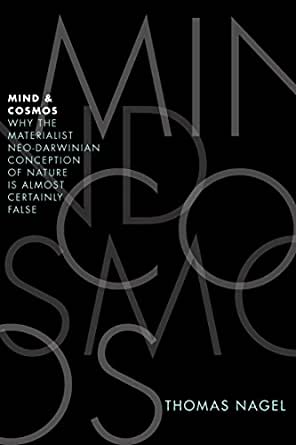
Nagel’s influential book
Thomas Nagel undertook this explanation in his essay “What Is It Like t`o be a Bat?” We can imagine that we could know every physical fact about bats from biology, but none of us would understand what bat-hood is actually like because we’re not bats. Furthermore, even if you transplanted human consciousness into a bat, all we would know is what it is like to have a bat-body, not to see, taste, experience, or think about life in bat-like ways.
Another famous thought experiment that shows the insufficiency of materialism to explain qualia is Frank Jackson’s Mary argument. Let’s say you take a child, named Mary, and lock her in a room with only black and white things. But you teach her every fact about color. She knows that red objects are any object which reflects light in Earth’s atmosphere at a certain wavelength. She could even measure that with appropriate tools. But until she *sees* something red, she doesn’t know what red is.
That’s because there’s something about seeing a red thing that is unique to the individual, something transmitted only to a minded thing outside of the brute physical facts: a quale. Now let’s turn to how that factors into our computational model of the brain. Under that model, we might make a statement like “pain is what happens when C-fibers are activated.” And we know that’s true from neuroscience. We can observe a brain under a fMRI and see that when c-fibers are firing, the subject should be experiencing pain. But if we ask the subject, we may get wildly varied responses based on pain tolerance, whether the person is kinky, etc.
There’s something about the subjective experience of pain not captured in the firing of c-fibers, and that is “what the experience of pain is like to that unique subject.” That item picked out by that term is a quale, and there’s no physical equivalent. No one has ever, or will ever, locate a quale under a microscope. It’s not the sort of thing one should expect to find there. It exists purely in the mind. It is a mental thing. But if it exists, then at least one non-material thing exists.
OBJECTION: but it still depends on biology! No one who doesn’t have a brain and c-fibers experiences pain, so pain is just something another part of the brain refers to the conscious subject to let it know it’s in pain. ANSWER: while it is true that brains and c-fibers appear necessary for minds to do what they do, there’s no indication it is necessarily so; parallel evolution of bodies, brains, and minds doesn’t imply that is the way it ALWAYS has to be.
FURTHER OBJECTION: we might consider the brain super complex, and with multiple systems interacting, and therefore the subjective experience of pain arises only relationally between those parts; it doesn’t belong a totally separate substance. ANSWER: this could be true, but you’re just kicking the hard problem can down the road. Now you have to explain “in what” that relational property is represented. For example, @phrost brought up a relational thing, “society,” which only exists with groups of humans. But “society,” though relational, is represented in ideo-material relations of people throughout history. As an ontological status, we know those things exists and we can predicate “society” upon things we otherwise know to exist.
If we want to predicate “the material equivalent of subjectivity” on something, we need to know what that is. “Ultra-super-complex brain structures we haven’t discovered yet” is wishful, optimistic thinking. It’s an article of materialist/naturalist faith. That is what I wish to avoid by being a dualist; I know, from my own experience and interacting with other people, that we all experience subjectivity. I’ve never met a philosophical zombie nor do I ever think I will. From that brute experiential fact, I can infer that we all possess qualia and that these qualia do not appear to inhere any physical substance; therefore, I must predicate them on an irreducible simple known as “the mind.” Provisionally, therefore, I must grant that minds can do things material cannot.
OBJECTION: how then do we explain causal interaction between the mind and the material world? This is the epiphenomenon objection. The answer, suggested to me by my dearly departed friend Erik, is “causally.” When I, in an earlier materialist phase of life, suggested that this was a *bad* answer because we don’t have a model of mental causation, he corrected me. We don’t have *any* coherent model of causation. Think about it: can you define “cause” and “effect” without reference to the terms “cause” or “effect?” The notion of causality itself is circular. Pace Hume, all we can observe is constant conjunction.
Pace Kant, we know that causality itself is one of the basic categories of judgment we impose upon experience to make it intelligible. But none of these tell us what causality is, just how we might recognize the causal relation. That being the case then, what real objection can the materialist lodge against mental -> material or material -> mental causation? None. That we cannot fully explain how changes in one cause changes in the other is inconsequential. All we need to know is that mental events have material causative power, and vice versa, to say that minds and brains do appear to interact, even if we do not understand all of the processes yet. I am not suggesting we will find a “mind messenger particle” or a noematon or something. I am suggesting that whatever the causally-interactive mechanism is, it is no more “spooky” than any other causal model.
Intentionality
Inside St. Paul’s cathedral
Next, let’s look at “intentionality.” Pace Husserl, “intentionality” is the about-ness of our thoughts. For example, if I think about seeing St. Paul’s Cathedral, I have in my mind the object of my thoughts: St. Paul’s Cathedral. If I go and visit it, I see the same thing.
Despite both mental acts (thinking about, seeing) having the same object, there is a difference: in one, the actual physical cathedral is before me. For Husserl, this didn’t matter; both “intuitions” (whether thought or perceptual) INTENDED the same object. If the object is present-at-hand, that intuition is called “fulfilled.” If the object is not present-at-hand, it is unfulfilled. But both of them intend the same object: thus, intentionality. This was a key feature of Husserl’s theory of mind, because all cognitive acts are INTENTIONAL. That is, they all possess an intention, even acts of pure fantasy and imagination. This intention is not equivalent to the thing itself, or else all cognitive acts would require presence-at-hand. Thus, the intended object is something MENTAL.
OBJECTION: but when you remember something, or imagine it, you’re just piecing together something in your mind from what you already know, so the memories themselves could be stored physically.
ANSWER: while true, show me in the brain where my memories of St. Paul’s Cathedral are stored; point to the precise cluster of neurons and neurotransmitters that signify St. Paul’s Cathedral. RESPONSE: that’s special pleading. Of course we can’t do that, but suppose we could. Would you still object? REPLY: of course I would, because those neurons aren’t the thing itself. Remember, the fulfilled intuition is the thing itself *as represented in the mind*.
Semantic Content
OK, back at it. In my reply on the Twin Earth experiment, the third irreducible material simple is “semantic content.” I had a professor, Ignacio Angelelli, explain it this way: let’s say we have 3 mathematicians at a conference, and you ask them about triangles. Each one has his or her own private thoughts about triangles, the concepts they possess. But they are also talking about objective triangles, that anyone can pick up and understand. If one of them does a proof on a blackboard, anyone at the conference will have… in their minds created THEIR OWN concept of triangle, and they they will also be referencing this objective (or maybe intersubjective) concept of triangle which exists independent of any particular mind.
Prof A. likened this to personal concepts being “windows” onto the greater, universal concept. But where do these “personal” concepts exist if not in the mind, in the same way as intended objects and qualia? The same objections and replies apply there as well. So we have three things that do not have, at present, a sufficient materialist explanation. Acting as reductio, then, we must reject our assumed premise: that mind is just something special a brain does.
The Prestige
(L-R) Andy Serkis, David Bowie, Hugh Jackman in The Prestige
Now, it’s time to add all the buts and caveats.
First, yes, nothing here precludes a materialist account of mind from ONE DAY being successful. But just be aware that by insisting that a sufficient materialist account must exist, one WILL exist, it’s an article of faith. Scientism, or the belief that all knowledge the in the world is fundamentally scientific, is a religious mode of thinking, and as a committed rationalist, I think we should avoid such thinking in rational matters (in religious matters is another; indulge faith all you want).
Second, this does not imply the existence of the “soul” or atman or whatever. There is good reason to think minds and brains ARE critically linked, for example, the presence of brain damage or hallucinogens or whatnot dramatically affecting mental states.
something about zombies goes here
Recall Sellar’s Chinese Room thought experiment: place a man in a room, give him a list of Chinese symbols and a method of translating them to English, and he will seem to be able to read Chinese, but never be able to speak a lick of it. That is what a computer does: a computer is good at taking inputs created by minded things and replicating them, perhaps in a convincing enough fashion to make you think you’re talking to another minded thing. But no computer has ever had a mind of its own. So for now, all we can say is that humans and animals with higher brain function appear to be minded creatures, so brains, particularly advanced brains, and minds seem to go together.
It remains to be seen whether we can have a mind separate from the brain, or a particular brain, and there are all sorts of fun thought experiments: teletransporter, brain-in-a-vat, etc. that explore these possibilities. That’s beyond the scope of this piece. My point here is simply to point out that there are good reasons for at least provisionally adopting substance dualism as the most rational hypothesis until we can somehow explain away the unique “hard problem” features of consciousness if ever. And I say the only reason we would is to rescue ontological naturalism from the conclusion that there may be more things of in this world than can be studied with empirical science, Horatio.